...check out this link that shows some outstanding work in Photoshop with some whimsical creativity.
http://pelfusion.com/inspiration/50-amazing-examples-of-photo-manipulation/
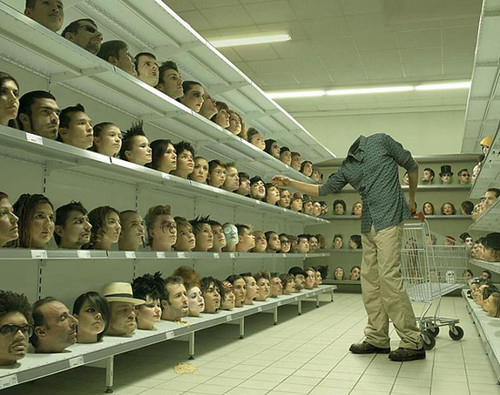 Example above created by Christophe Huet. Example above created by Christophe Huet.
 Create solely for the joy of it.
Let curiosity drive you.
Abandon your need to fit in.
Nourish the child in you and let this child come out to play.
Give yourself permission to be eccentric, even outrageous.
Dismiss the judge in you that sets rules and boundaries.
Experience something new each day.
Look at the world as if you were an ant, egret or alien.
Take time to vegetate without being afraid you are wasting time.
Ask what if.
(Also posted at Will Walnut's site here.)
© Bonnie J. Schupp

Fertilize the Mind
How is an idea born? Paradoxically, the answer remains an enigma even to those who spend their lives creating ideas.
Designers who talk about their creativity in the book, A Smile in the Mind, by Beryl McAlhone, all work with basic elements of the creative process: fluency, the process of developing a multitude of ideas; flexibility, the ability to see different approaches; originality the result of new combinations; and elaboration, building on these ideas. However, none of these designers can concretely explain how original connections happen. There is no road map, no template to follow. Instead, people use various techniques to fertilize the mental ground where these ideas grow.
Getting Started
Like many designers, Milton Glaser starts with words and, as in any communication process, he begins with what the audience knows. He uses familiar clichés as the medium to establish the context. However, this is only the beginning of the process. "You must use clichés to set the stage and then twist it in such a way to disrupt it." Once the audience recognizes the cliché, the context, then the cliché needs to be "detoxified." Glaser discusses the importance of shaking up expectation. He says the successful execution of wit is the "penetration of the immunity of an audience." When the cliché they understand does not follow through in the expected way, it breaks through the immunity. This wit is what people remember.
There are a number of creative "models" (CPS Model, James Higgins Model, de Bono's Six Thinking Hats, etc.) which attempt to be templates for the creative thought process. Glaser, however, talks about how creativity is not a rational process. You cannot generate ideas if you are traveling a linear path. Often ideas are born not only off the path but also on different levels. Picture an idea as a living thing meandering on a flat piece of paper on a desk. In this scenario, there is a limit to where the idea may travel.
Now picture an idea meandering in and out on the crinkles of a balled up paper, taking flight on a ribbon of steam from a coffee cup, grabbing the sound wave of a ringing phone and then hopping back on the ball of paper. Infinite possibilities abound on this second journey. The important thing is to keep an open mind about how and where ideas may travel.
Be Ready
Some people use certain mechanisms for triggering ideas, such as talking with others, starting something new, sleeping, smelling apples or walking. I find that most of my ideas come while walking or driving. Usually when I walk, I carry pen and paper to jot down ideas before they are lost. On several occasions, while driving I've become so wrapped up in the flow of ideas from so many directions that I have wound up lost in a stranger's driveway. Glaser suggests that ideas happen when you allow yourself, in a relaxed state, to go off on tangents. Most of the designers in this book say their ideas come when they are not thinking about the project. They allow the subconscious to work and make connections. Bill Moyers reminds us that you must "pay attention to your preconscious self that slips messages to you, much as a note is slid under the door."
Glaser says it helps to place yourself in a state of readiness. In order to discover concealed relationships, you must be ready to accept them. This cannot be willed. "Ideas happen when you release your mind from its willful demand for something to happen." You cannot insist on getting an idea, for instance, by four o'clock this afternoon. I've always understood this. As an undergraduate student at Frostburg, I became upset when my creative writing teacher announced that we would take a creative writing exam at a scheduled time. Creativity does not happen by arriving at a two o'clock exam and following a prompt to create on demand. I took a big risk and protested this philosophy. I showed up at the scheduled test time, ignored the creative writing exam, and wrote about why I was refusing to take the exam and how I perceived the flow of the creative process. What I wrote must have made sense to the professor because I received an A for the course.
Filling in the Spaces
Finally, Glaser looks at design as narration and suggests that the most important element is what is left out. It is important for the viewer to complete the communication by connecting with what is not said, with what is not shown. This pulls the audience in as collaborators in the creative process. Many teachers complain about the lack of student imagination and creativity. David Thornburg calls creativity the "new scarcity" in educational institutions and Jonas Salk says our future depends on creativity. Perhaps today's students may not be challenged enough to fill in spaces. Audience participation might also be the reason why reading a book is almost always better than seeing a movie. The reader must fill in more spaces when reading, while movies tend to complete things for the viewer. When the audience participates, there is an intrinsic sense of satisfaction in making the connection. And often this connection does not stop with the "aha" moment. The audience not only remembers the message, but also uses imagination for further elaboration of their own.
It is the process of filling in spaces, putting yourself in a state of readiness and giving yourself permission to meander that fertilizes the mind for creative growth. You may be unable to describe the birth of an idea but you can certainly put out the welcome mat.
© Bonnie J. Schupp


