Thirty years ago, I opened my home to strangers from all over the world. Likewise, around the globe, people I’ve never met have invited me to stay in their homes. I do this because of a belief in the importance of connectionsto overcome prejudices and fears. It has been a step toward creating a wonderfully rich life. Part of the richness of my life is reaching out to people who seem to be different from me and then discovering we’re not so different at all.
Today, the traveling piano man, Danny Kean, and his dog Boner just left after staying six nights at our home. My husband David and I had never met him but when he e-mailed me about staying for two nights with us, I told him more than two nights were fine.
And I’m glad he stayed longer.
Danny sold his house and leaped big-time into uncertainty. Most of us are afraid of uncertainty, otherwise we wouldn’t be afraid of death. Confronting uncertainty and immersing himself in the present, Danny has taken a leap of faith that the path he has chosen will continue to enrich his life as well as others.
He travels with Boner next to him and a piano on the back of his red pickup truck. During the day, he stops here and there and brings a gift of music. It might be in a park or on a street corner. It might be on the beach or in front of your house.
A gift of musicand Boner too
The gift of music is not merely his piano playing, although he belts out a fantastic rendition of Nola and various high energy ragtime music and soothes the soul with free-spirited improvisations. His
gift is empowering others with creativity and music they may not have known they had in them.
You see, when Danny pulls his truck over, he invites people to his truck. Part of his gift is Boner too. Danny wants the world to meet Boner who is more than 14 years old and who perches on tops of the piano on the truck bed. Boner greets curious visitors who approach and seems perfectly content to be part of this music experience.
Danny invites people to climb aboard the bed of his truck and sit at his piano and play. Most people are shy and are reluctant to do this, probably because they feel they can’t play the piano. Before you know it, Danny has talked them into playing. With gentle persuasion, he encourages them. He says that even one note is music. Then he tells them he’ll count to 60 and they should play until he gets to 60. He counts quietly out loud and somehow untrained fingers begin to create music.
I saw a young woman on her birthday, who reluctantly sat down and played while her three children listened in surprise. I saw a young husband and his pregnant wife play together for their unborn baby. These people had no training but you could see the change in their faces as Danny allowed them to be free, encouraging them along the way. He empowers people to get in touch with themselves through music.
We’ll miss Danny and Boner and their special magic and hope they’ll visit us again.
Servas
I haven’t answered the question about how we go about meeting these strangers all over the world. Thereare three organizations that we’ve had experience with: Couch Surfing, Hospitality Club and Servas.
We’ve had the most experience with Servas which was founded in 1949 by Bob Luitweiler and some friends who envisioned a grass-roots movement toward world peace by people opening their homes to one another. We’d just experienced a second world war and it seemed we couldn’t depend on our leaders to prevent a third world war. It sounds idealistic and perhaps it is, but it works for those who are open to this experience.
I like to tell people that I used to look at a map and see only names of places. Now, after 30 years with Servas, I look at a map and see names of places where my friends live.
Travel is fatal to prejudice, bigotry and narrow-mindedness, and many of our people need it sorely. Broad, wholesome, charitable views cannot be acquired by vegetating in one's little corner of earth.(Mark Twain)
For two years, I challenged people to answer this question: How do you define yourself? I asked people to respond in one sentence of any length beginning with I am... After they answered, I photographed them to illustrate the self-definitions. I received nearly 100 responses from people ages 4 to 100 representing 15 countries. Participants are diverse and include a Holocaust survivor, transgenders, gays, lesbians, a pilot, a police officer, poets, musicians, Muslims, Jews, Christians and athesists. Some people are well-known in their fields but most are not in the public eye.
During those two years, the project took on a life of its own. Perhaps it is best said in an African proverb: We are because I am. I am because we are.
Below are photos of my response and that of my father who was the inspiration for this project, and the talk I give about this two-year photo/word project.
Defining Ourselves
A two-year international and multi-generational photo and word project examining who we are
Background
It’s funny how small things can grow. Take words, for example. Off-hand words are not usually meant to inspire or start anything. but it is what the listener does with the words that plants a seed.
This is what happened to me.
My father has Parkinson’s disease. One day, he was trying to perform an ordinary everyday action and, frustrated with a shaking hand, he said, “Bonnie, this isn’t me.”
Hearing those words awakened something in me and I wondered how he defines himeself. Then I wondered how I would define myself. The seed was planted and it grew.
Beginnings
I spent the next two years reaching out to family, friends, acquaintances and strangers, challenging them to answer a question that goes to the core of their being.
The challenge question was this: “How do you define yourself? Answer in one sentence that begins with ‘I am...”
Some people I asked had never thought about who they are on any level of depth. Like many of us, they habitually go about their everyday lives, bobbing along on an ocean of chores and necessities.
Some people wondered why I was asking this question at all. Good question.
My answer? I believe that in order to appreciate the past, live in the moment and approach the future, we must have an understanding of who we are. And, in order to connect with our world—our environment, other people and our own spirits—we have to examine ourselves at our core. If we are unable to wrap ourselves around our own self-definition, then our lives and connections fall short of what is possible.
Defining Myself
Before asking anyone else to answer this question, I knew I had to take on the task of defining myself.
After much thought, this is my self-definition:
I am a child of the universe who lives a rich life
of creativity, connections and possibilities.
I said child of the universe... child, yes, because I wonder, explore, feel, grow, find delight, learn, walk daringly into emotional minefields — all in a setting of naiveté, trust and optimism. Yes, a child’s point-of-view.
Of the universe suggests my membership in something larger than I am.
In considering the rest of the definition, I thought about what elements of my life, if they were to disappear, would cause me to feel less alive. The answer? I must create and I must connect. My creativity can take many forms.
My connections are with people , environment and spirit.
Possibilities...suggests growth, adventure, change. If we ever lose our sense of possibilities, then we are in the process of dying.
Finally, I consider my life to be rich because of shared energy in all its facets. It is a layered life rather than a linear one. Underlying my definition, my essence, is a broad sense of love.
So, my definition does not depend on my job/career and it doesn’t necessarily depend on my health. I can still be who I am...regardless.
The Process, Considerations
Once I had my own definition, then I could begin asking other people to define themselves. It started with family and friends. Then it extended to friends of friends and sometimes strangers who I approached with this question. Some never answered while others were intrigued by the question.
One thing I stood firm on. I refused to share anyone’s answer with those who were still struggling to find their own. This was uncomfortable for many. They wanted sample answers. They wanted to make sure they answered correctly and in the way I expected. My only condition was it had to be one sentence, of any length, that began with “I am.” I assured people that there were no right or wrong answers unless they didn’t follow those two conditions. Whatever they said would be correct because they were defining themselves and they knew themselves better than I did. Who was I to say they were wrong?
After I received each response, I then shared other answers and portraits. We scheduled a time to do a collaborative portrait that illustrated the self-definition. Logistics were difficult because people were spread around the globe. I made a 600-mile detour to Indiana to get one portrait. For another I flew to California and for another I drove to upstate New York. Some were taken in Japan. One problem I hadn’t anticipated was the difficulty there would be in scheduling time for the portraits. We’re talking about busy people. And some had the idea that this was a small on-going project with no end. They kept saying, “One day we’ll get together to do this.”
A few people responded through e-mail but, because of distance and time, we were unable to connect for a portrait.
Once time was scheduled, then we usually worked together to come up with the concept. As a photographer used to doing my own thing in my own way, this was a different kind of challenge for me. There were two of us working on the portrait. Some people were uncomfortable with showing their faces or being in front of a camera lens at all. I didn’t want to use anything that made someone uncomfortable but, at the same time, I insisted on remaining true to my concept. (If you want to know more about technical details such as camera, lights, etc., you can talk with me later.)
In spite of all the challenges, somehow, over the course of two years, this project has come to fruition. Amazing.
Answers have come from people ages 4 to 100 representing 12 countries. Responses include a Holocaust survivor, transgendered people, gays, lesbians, an airline pilot, Arabs, Jews, Christians. Most participants are not in the public eye – just ordinary people. However, some are known locally and internationally.
The Responses
It fascinates me how people answered this question.
Of all the responses, 24% include career and hobbies in their definitions. Of course, this is not surprising. Consider how many hours a typical person might work at a job/career in a lifetime. Probably more than 93,000 hours, considering working ages 20 to 65.
Twelve percent mention God, spirit or the divine. This includes a wide range of believers and non-believers from various religious backgrounds.
And don’t forget love. Fifteen percent of those who responded to my question have “love” or a form of the word in their definitions. Petronio Bendito says it best in one of my favorite responses, “I am all that I love.” Many self-definitions made me think, but this one the most.
It is most significant that almost half—42%—defined themselves by their relationships. The percentage is even higher when you consider the definitions that imply relationships. This is the area of greatest similarly among respondents. I don’t think anyone would dispute the importance of relationships and how they lead us to new emotional places and better understanding of who we are.
Fred Muir, a Unitarian Universalist minister who participated in this project, puts it succinctly in his self-definition, “I am my relationships.”
It is noteworthy that most people did not define themselves by their nationality or race. Nine percent included age or age-related terms, the majority being young people. Thirteen percent used gender as part of their definitions but none of these were the two transgendered participants.
I find it interesting that 12% expressed a dichotomy, a feeling of the complexity and tug and pull of their being. How often have all of us felt fragmented and torn? How many of us sometimes do battle inside ourselves when making decisions? Recognition of this dichotomy is recognition of our full humanness. Joe Justice, police officer, said it well, “I am simple and complex, logical but emotional, aware yet eternally ignorant, powerful although miniscule—all of these dichotomies because I am human.”
In defining ourselves, there is a consideration of time. Ten percent connected in some way with time... past, present or future. Dirk Hamilton’s, the shortest definition, states simply, “I am here.” However, it is a deceptively simple answer. Those words imply that he embraces and lives in the present, an important tenet of Eckhart Tolle’s book, A New Earth where he says, “People who are able to be present in the now are closest to the essence of their true being.”
In President Carter’s famous “malaise” speech, he pointed out, “Human identity is no longer defined by what one does, but by what one owns.” It is heartening that not one person in this project sought identity through ownership.
Seven percent of the people who responded to my question recognized an evolving self. For some, including my husband, before defining themselves, it was important to understand that who they are today may not be who they are tomorrow. A former student of mine, Justin Wainio, defined himself with this contradiction in mind, “I am always changing while always staying the same.” Anais Nin has an interesting comment in her diary. She says it’s impossible to define yourself because of possibilities. “How can I accept a limited definable self when I feel in me all possibilities? ... I never feel the four walls around the substance of the self, the core. I feel only space.”
In fact, five percent mentioned “possibilities.” This perspective looks forward into the future for what can change, what can be and who we can further become. There is an openness in those who included “possibilities” ... an openness and acceptance of the evolution of “becoming.”
Final Thoughts
This has been a difficult but exciting journey inspired by my father’s comment and it grew into something much larger than I’d anticipated. I learned from everyone who answered and I discovered something part way into the project. This whole thing is not really about me or any one person. It’s about the you and me that makes up the we. Over the past two years, it has taken on a life of its own and I no longer own it. It is ours. Perhaps it is said best in an African Proverb:
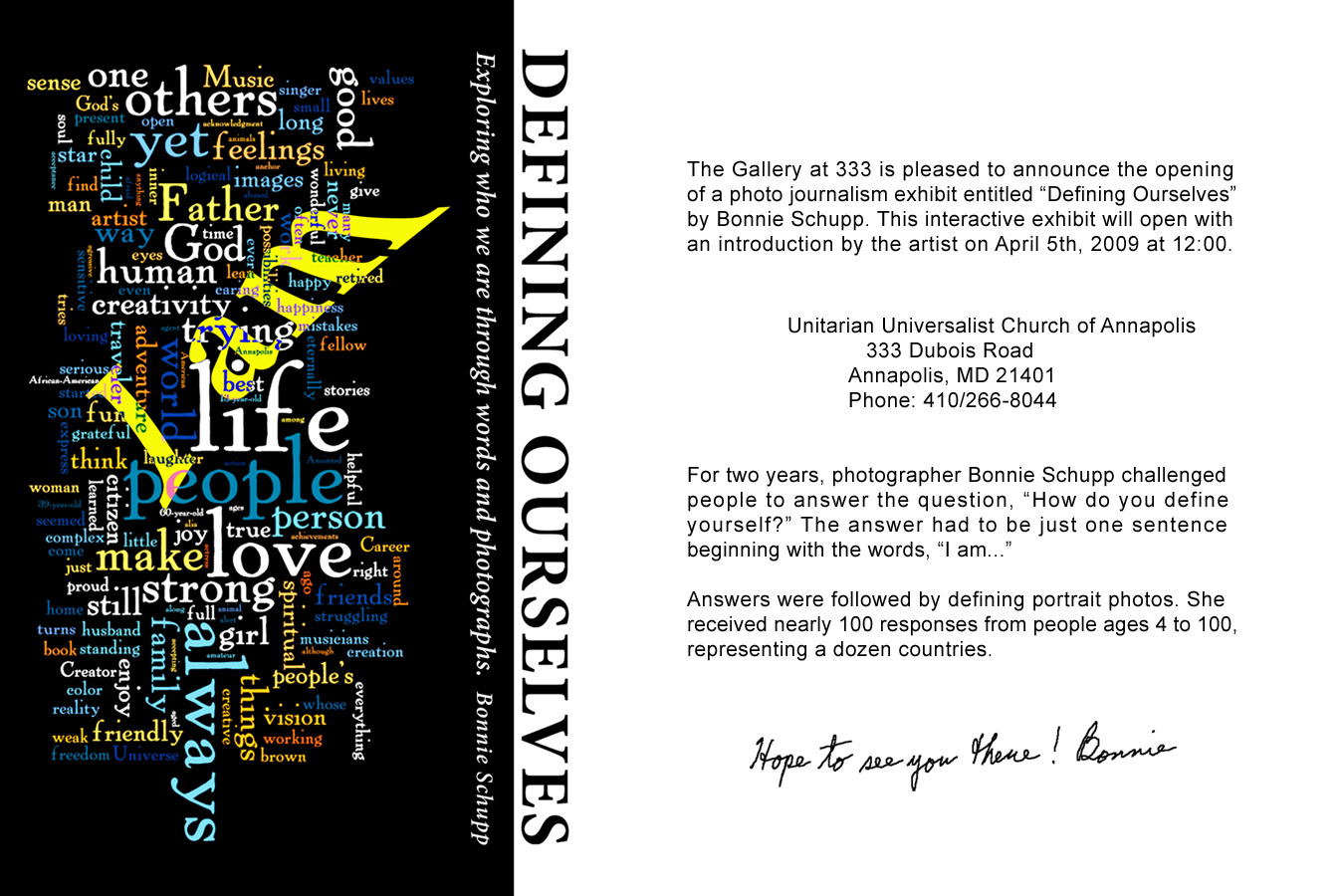
For two years, photographer Bonnie Schupp challenged people to answer the question, "How do you define yourself?" The answer had to be just one sentence beginning with the words, "I am..." Answers were followed by defining portrait photos. She received nearly 100 responses from people ages 4 to 100, representing a dozen countries.
Exhibit opening:Sunday, April 5, 12 - 1:30 p.m.
333 Gallery Unitarian Universalist Church of Annapolis 333 Dubois Rd. Annapolis, MD 21401
The title alone will give you an idea of the creativity in this book, Parallel Perspectives. One of my pictures was chosen for this beautiful coffee table book published by iStockphoto. Pictures are paired on opposite pages and each photo relates to the other in some way.
Some relate to one another through subject and some through composition or color. Pairings might be humorous, poignant, startling or inspiring. In fact, the entire book will inspire you.
I was an avid reader as a child. The Enoch Pratt Library bookmobile came every other week to my elementary school, Brehms Lane in BaltimoreCity. I checked out lots of art books and some fiction.
But I wasn’t lacking for books at home either. I spent my $1 weekly allowance on either film for my camera or books. I had a 50-book collection of The Bobsey Twins along with other popular books at the time: Albert Payson Terhune’s dog books, Walter Farley’s horse books, and various mysters— Nancy Drew, Dana Girls, Trixie Beldon.
I could also go downstairs to our basement and find books such as the American Kennel Association’s thick book of pictures of all the approved dog breeds. I could look up anything in the complete set of The Book of Knowedge.
I remember finding a thick green book. Most books were hardbacks then and had no book jacket with a synopsis and other information. The title on this green book was Uncle Tom’s Cabin. I picked it up and read it, losing myself in a time and place strange to me.
This was in the 1950’s. We didn’t have slavery any more. My grandmother did, however, have a “colored” maid named Martha. I never did know her last name. Although my sisters and I were always taught to call adults Mr., Miss or Mrs. (this was before Ms.), we only knew my grandmother’s maid as Martha. Funny thing was that, at the time, I didn’t question why we were allowed to call an adult by her first name.
I read Uncle Tom’s Cabin, grew to love the slave characters in the book and cried at the sad parts. I re-read the book one or two times more. I felt close to the characters. They were like family. I was happy when they were happy and suffered with them through their miseries.
I once heard a speaker from the National Endowment for the Arts talk about how lack of reading, fiction in particular, was affecting involvement in the arts, including the performing arts. We were becoming a nation without imagination and curiosity, a people who didn’t find pleasure in fantasy and pretend, a community interested in facts more than play.
I think there’s another effect, too. Waning empathy. I remember how I climbed inside the heads and hearts of the characters in Harriet Beecher Stowe’s novel. I felt for them. I imagined their feelings. I learned to empathize.
Stowe's influential novel about slavery, Uncle Tom's Cabin, or Life Among the Lowly, was first published in book form March 20, 1852, by J.P. Jewett of Boston. The text had previously been serialized in the anti-slavery newspaper, the National Era.
10,000 copies were sold in the first week, 300,000 within the first year. The many different editions published in Europe sold an aggregate of one million copies in the first year. It was the second-best-selling book of the 19th century after the Bible.
In February 1963 in the year February graduations took place in Maryland, I graduated from Eastern High School, an all girls public high school in Baltimore City.
March 19, 1963, folk singer Pete Seeger was making news. He and some other musicians involved in political protest of that era were banned from Hootenanny, a popular weekly musical television show. He protested the Vietnam War and participated in the civil rights movement. His song, We Shall Overcome, has become a classic. Seeger performed with Bruce Springsteen at the 2009 Presidential Concert, two days before the inauguration of Barack Obama. (Photo http://www.hrcr.org) Seeger will be turning 90 this year.
Today is March 16. On this day in 1827, the first newspaper owned and edited by and for African-Americans, Freedom's Journal, was published in New York City. It appeared the same year slavery was abolished in New York state. On this day in 1972, librarian Zoia Horn went to jail, protesting that libraries should not become places for spying and infiltration. And on this day in 2003 a 23-year-old American college student, Rachel Corrie was killed in Gaza as she protested Israeli action there. She was run over by a bulldozer while trying to stop Israeli troops from demolishing a Palestinian home. She was the first nonviolent western protester to die in the occupied territories. See here for more information.
In case you were wondering what we did this weekend...
Friday night, we saw a screening of the documentary movie, Darius Goes West. Darius Weems has Duchenne Muscular Dystrophy and travels across the country with eleven friends on a mission. Watch this video. It explains everything. We met Darius at The Windup Space where the movie was shown. The movie is uplifting and creates awareness of Duchenne multiple sclerosis. It's one I highly recommend especially for students.
Saturday morning, I photographed the Baltimore Burn women's football team during their practice. Women between the ages of 19 and 49, from diverse backgrounds, turned out for a grueling practice on Saturday morning. I'm not all that interested in football but had a great time shooting the pictures. They are a diversified, talented, friendly...and tough group of women.
Saturday afternoon was the opening of Connie Imboden's photography exhibit. If you are unfamiliar with her work, you should check out her Web site. Her photos, some taken in a swimming pool, others taken with mirrors, are dark literally and figuratively and reach out to those hidden corners within us. You cannot remain unmoved by her images. The image here is from the cover of her new book, Reflections, 25 Years of Photography. In his essay in the book, Julian Cox describes Imboden's work as "passionate, haunting, beautiful and terrifying."
Saturday night we had tickets for the late performance of O'Malley's March, Maryland Governor Martin O'Malley's band. The occasion was the release of their new CD. I'd never heard the group before but I'd seen O'Malley in an impromptu Blues Traveler performance at Art Scape. I enjoyed this Saturday night performance. This performance was high energy celtic music played with the pureness of musicians who love what they're doing. Their enthusiasm generates a joy in the audience that creates a hangover of the best kind.
Finally, we were able to catch the last set of Kevin Robinson's group, LA&the Unusual Suspects, at the Fireside Inn in Glen Burnie. The talented group plays a mix of motown rock and soul. They inspire listeners to move and move some more. Friday night was no exception.
I first heard Kevin at the Baltimore Museum of Art at a special event where artists were invited to respond to paintings in the museum's collection. Kevin played an original composition inspired by Matisse's Blue Nude. The depth and texture of his music and performance drew me in.
A walk to yonder, in the middle of a clearing peppered with old beer cans,and a look in a pile of rubbish turned up a book and a handwritten note. The book was a paperback edition of Listening to Prozac by Peter D. Kramer. The note was printed in ink and dated March 11. From the freshness of the paper, it was probably this past Wednesday.
“Woke with high hopes at 10:00, shower and clothing handy. Hopes of friends today, but fell ill. Now in woods, big clearning with beer cans and firepits. The constant movement of animals disturbs me. Plans of smoking more weed in secluded spot. Wheathor overcast and cold with threat
of rain. Plan for today is nothing. Feelings of depression to arrive back. Forest is newly burnt (to kill ticks I presume?) and still smells of charcoal. No paranormal activity detected today, though .........[?] Luckily I am protected
by the seed of the tetragrammaton and Elbereth, etc. [?] will [?] for something [?] Sadly the moon waxes strong tonight but the clouds will obscure it's view. I do pine for it’s rays.”
What does it all mean?
Took the note but left one in its place:
“Dear Note Writer,
You are not alone.
Love,
Me”
(If this sort of thing fascinates you too, you might want to check out Found.)
As of 5 p.m. today, this was one of the top sellers on Blurb and one of my pictures is in it. Click on the book cover image to check it out.
“We're happy to announce that Parallel Perspectives, the first iStockphoto coffee table book, is ready. And it's hot.
There are more than 65,000 iStock artists around the world now. We wanted to capture the unique, personal moments all those different sets of eyes have witnessed in their corner of the world. This book is our visual atlas: the world as iStock sees it.
The book is available at Blurb in both paperback and hardcover. 100% of the proceeds from the sales will be donated to Charity: Water. So not only are you getting the best of iStock to put on your coffee table, but you're helping out a great cause.” http://www.charitywater.org/
David’s Aunt Alice just celebrated her 102nd birthday wearing a sparkling dollar store tiara and matching plastic earrings. Alice reminded us (several dozen times), “Each day is a gift.”
After a snow storm, this morning I looked outside my window and found a gift. This Japanese Red Maple, denuded by winter, wore thousands of diamonds. Priceless!
It’s hard to break old habits. George W. Bush was a great leader...when it came to division. Not exactly something to be proud of. Now the Republicans seem to be in a deep rut created by the habit of Republican politics...the habit of wearing blinders that allow only an us vs. them perspective.
Why are they against the stimulus bill? Have they even read it? Can they read? It seems not when you look at the claims they’re making about the bill. And when will they stop their lies?
Here’s a quick summary of GOP stimulus myths listed by FactCheck.Org today:
Summary
Many claims of Democrats slipping in earmarks for frivolous projects aren't true.
Do some of the Republican claims you've heard about the stimulus bill sound too awful to be true? We find a few that are wildly exaggerated or downright false.
·It's not true that the bill contains spending for "golf carts." It has $300 million to buy fuel-efficient vehicles, some of which may be electric cart-like utility vehicles.
·Money claimed to be for "remodeled federal offices" is mostly designated for upgrading buildings to "green" status through such things as thicker insulation and highly efficient lighting, not new drapes or paneling.
·A widely repeated claim that $8 billion is set aside for a "levitating train" to Disneyland is untrue. That total is for unspecified high-speed rail projects, and some of it may or may not end up going to a proposed 300-mph "maglev" train connecting Anaheim, Calif., with Las Vegas.
·There's no money in the bill specified for butterfly parks, Frisbee golf courses or water slides, despite a GOP congressman's claim that the bill "will fund" those projects. He culled those silly-sounding items from a list of 18,750 city projects that the U.S. Conference of Mayors cobbled together in January as examples of "shovel-ready" projects.
Let's hope that the President can pull the Republicans out of their rut.
(The picture at the top shows President Obama's speech tonight configured as a Word Cloud. )
Bonnie J. Schupp (1944-2021) was raised in Baltimore and graduated from old Eastern High School in Feb. 1963. She earned a bachelor's degree from Frostburg State College, her master's from Johns Hopkins University, and, at age 60, a doctorate in communications design from the University of Baltimore. She was over the years a public school teacher, camera store owner, writer and award-winning photographer, and mother of two daughters,. She self-published half a dozen books combining her writing and photographs, notable among them "Dog Tag Poetry" (2012, Blurb Books), "365 Gifts on Turning 70" (2016, Amazon), and, posthumously, her memoir "Curious Possibilities" (2021, Amazon) edited by her husband, David M. Ettlin.

 eet Boner who is more than 14 years old and who perches on tops of the piano on the truck bed. Boner greets curious visitors who approach and seems perfectly content to be part of this music experience.