(If we live with an open and
grateful attitude, every day will bring a gift. This is one of 365 gifts during
the year I turned 70.)
The theme of the small art show at Roman’s Place
was candy, specifically Halloween candy, and the opening was tonight. I am
always awed with the depth and breadth of creativity found in art exhibits, toy
stores and specialty venues. In the past, I have bought items merely because I
admired the inventiveness and imagination that gave it birth.
Imagination is more important than knowledge. For knowledge
is limited to all we now know and understand, while imagination embraces the
entire world, and all there ever will be to know and understand.” ~ Albert
Einstein
This candy exhibit at Roman’s is small but it is
big in imagination such as a mask made of candy wrappers. Photographer Jim Burger, organizer of this exhibit, shows a photo of a
woman, from the shoulders up but presumably naked, standing in front of the
brown remnants of a cornfield and throwing candy corn up in the air against a
mostly blue sky. His concept and execution are remarkable. Another piece, a
sweet 3D, displays an assortment of previously licked and then shellacked round
lollipops sticking out from a white base. Clever titles like Sugar Daddy
made me chuckle. There is a series of drawings of mug shots, people arrested for crimes against Halloween, like a man accused of distributing toothbrushes instead of candy.
My hanging photo poster is a close-up—ribbons of sugarcoated
rainbow candy. It is secured to the wall with whimsical monster finger puppets.
I have played with these finger puppets merely because they make me smile. Anyone
who eats this candy might be even more inclined toward laughter, silliness and
sudden urges to bake and eat brownies. However, my eye, rather than my taste
buds, is what drew me to the color, patterns and texture. Too bad that this
beautiful Colorado candy is not available locally because it is illegal in
Maryland. But it is not illegal to sell a photo of it—which I did.
Catch the love at the Creative Alliance in Baltimore, Thursday, August 23, 2012.
Bonnie Schupp has been
recognized for her work by Kodak, Women in Photography International, the
Kinsey Institute, among others. She has shown one-woman exhibits in the
Baltimore-Washington area, and her photos and articles have appeared in
publications including Petersen’s Photographic, Darkroom Photography, the
Baltimore Sun newspapers, the Baltimore Business Journal and the Photographic
Society of America.The Love Effect is a play on the concept
of The Butterfly Effect where a small change in one place can result in
changes elsewhere, a concept that is at the heart of the Baltimore Love
Project. http://bonnieschupp.com
Learn more about the Baltimore Love Project and see photos of the walls completed so far:
Showing through May 15, 2011 at the Baltimore Museum of Art (Photo by Bonnie J. Schupp)
Baltimore used to have an annual art show around either Montebello Lake or Druid Hill Lake. My memory is a little fuzzy but I do remember when I was rejected sometime in the 1960’s. To participate in this unjuried art show, one merely had to sign a form. I wish I could find my rejection letter but it essentially said I couldn’t show because photography was not art. I believe this line of thinking had something to do with how photos were made…with a mechanical device.
We’ve come a long way since then.
People used to say that “the camera never lies.” Not anymore. Now we recognize that the photographer can bend the light waves of truth around her own perception, leading to a new interpretation of “reality.” (And, of course, there’s always Photoshop.) Choices of camera angle, cropping, timing, color, format and presentation are determined by the artist’s personal vision and interpretation.
In 2008 the Baltimore Museum of Art presented Through the Lens: Photography 1900-1960 featuring works by Man Ray, Alfred Stieglitz, Edward Weston, Paul Strand, Dorothea Lange, Gordon Parks and Harry Callahan. Along with this exhibit, some contemporary artists such as MICA’s Connie Imboden were invited to interpret the exhibition’s ideas with their own work. In addition to this, the community was invited to create digital images inspired by this show. One of my pieces was chosen for the digital gallery.
At the BMA (Photo by Bonnie J. Schupp)
Now in 2011, the BMA is showing Seeing Now: Photography Since 1960, a collection of more than 200 images featuring works of 60 modern photographers. Artists include Cindy Sherman, Diane Arbus, Garry Winogrand and Robert Frank, among others. The exhibit is clustered in five groups: Seeing Pictures, Seeing People, Seeing Places, Seeing Performance, and Seeing Photography.
You can read an excellent review by Cara Ober of the Urbanite here.
Instead of duplicating what others have already done well, I’ll add a few personal observations.
Humanity dominates the art in this exhibit. Even in those images that have no humans within the frame, they draw the viewer in and the viewer becomes the missing person connected with the photograph.
There were some things that I “didn’t get,” such as the videos with the artists continually saying, “Good morning” and “Good night.” However, exposure to art which stretches how you see both art and reality leads us to a more multi-layered life. After all, the mission of art is to push us toward seeing things in new ways, to demand that we think about things even when we want to ignore them, to help us connect the past and present and move toward the future, and to question where we are in time.
In the past, photography exhibits always had a simple black frame around a matted photograph. In this exhibit format is more varied. There are numerous white frames and even one where a decorative frame seems to be part of the art.
This was the first exhibit I have seen which uses smartphone technology. If your cell phone has the proper app downloaded, you can scan the bar code below some of the photos. Just as the museum reached out to the broader community with Through the Lens, once again a broader community has been invited to participate. This time, the bar code scan will call up a link about that image that points you to some of Nate Larson’s MICA students who have responded to these works.
Finally, there are several pieces where words and images are equally part of the art. I predict we will see this marriage of words and images more frequently in the future. *
During the past few years, I’ve worked on connections between words and images. In Defining Ourselves, the words were those of my subjects and the photos were collaborative between subject and photographer. Presently I’m working on another long-term project, Together 40+, where my subjects must respond verbally before they sit in front of the camera. And another daily word/image project I’m working on for 2011 is Dog Tag Poetry. This blending of words and images adds a new layer—and challenge—to my photography vision.
Don't miss Seeing Now: Photography Since 1960 at the Baltimore Museum of Art. It will force you to question and change your perception of reality.
Check out these links.....................................................
“Defining Ourselves” has shown in Annapolis, Fairfax, Rockville and Baltimore. I was also interviewed on WYPR’s The Signal.
Have a heartThe opening reception of my Defining Ourselves exhibit, the third showing, took place Friday, January 15, 2010, at the Light Gallery, 1015 North Charles St. in Baltimore. It was phenomenal! The exhibit seemed to have sparked intriguing conversation during those two hours. Kevin Robinson provided some live music and those who attended offered energy to the occasion.
David told everyone that, if they had to make a choice, they should donate toward relief efforts in Haiti rather than buying my art. I agree with him. Although making money is a positive thing, helping others is much more important.
Photography exhibit opens in Baltimore, a two-year international and multi-generational photo and word project examining who we are
Opening reception Friday, January 15, 7-9 p.m. at the Light Gallery, 1015 North Charles St., Baltimore.
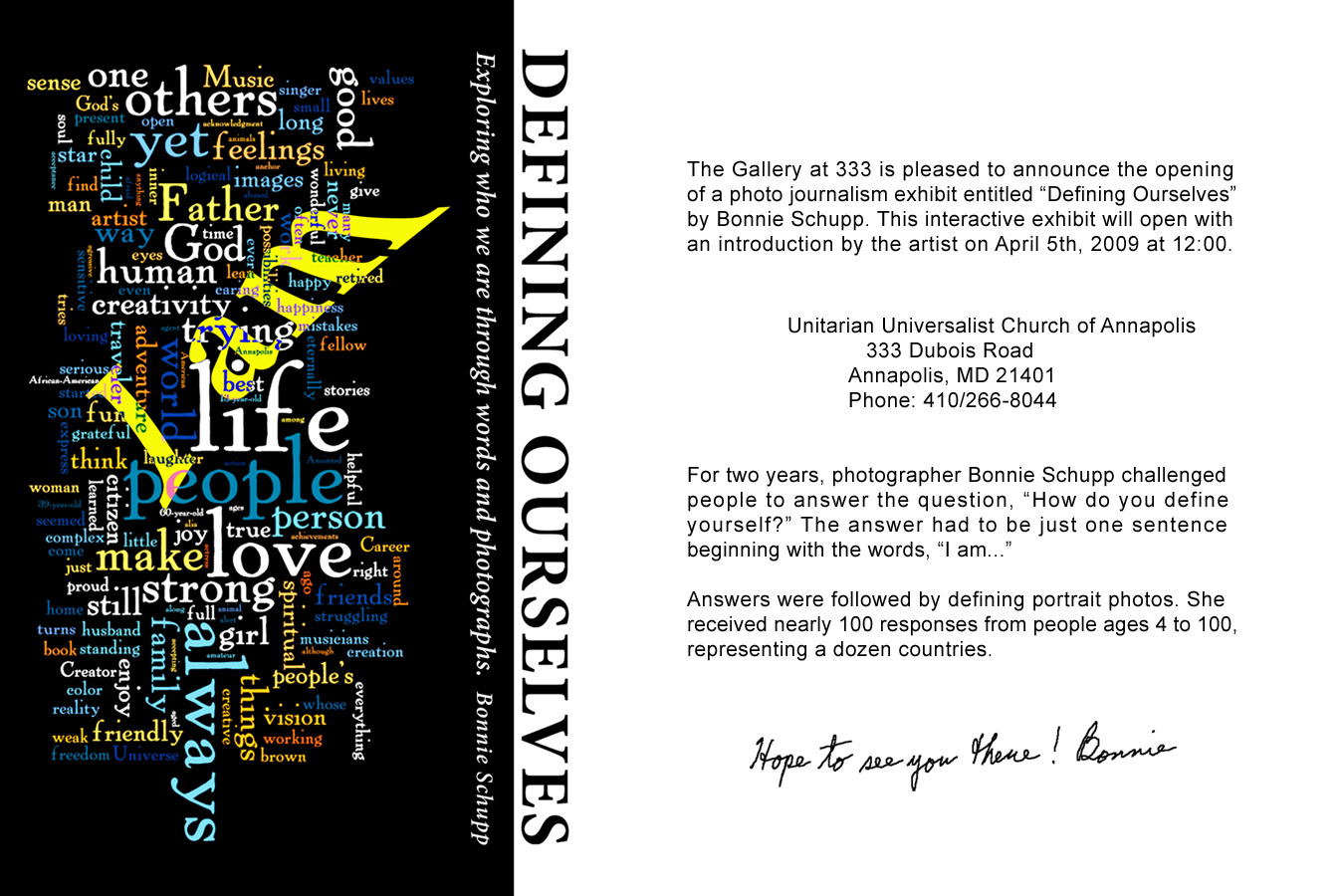
For two years, I challenged people to answer the question, "How do you define yourself?" The answer had to be just one sentence beginning with the words, "I am..." Answers were followed by defining portrait photos. She received nearly 100 responses from people ages 4 to 100, representing 14 countries.
See a preview of the portraits without the words here:
For two years, I challenged people to answer this question: How do you define yourself? I asked people to respond in one sentence of any length beginning with I am... After they answered, I photographed them to illustrate the self-definitions. I received nearly 100 responses from people ages 4 to 100 representing 15 countries. Participants are diverse and include a Holocaust survivor, transgenders, gays, lesbians, a pilot, a police officer, poets, musicians, Muslims, Jews, Christians and athesists. Some people are well-known in their fields but most are not in the public eye.
During those two years, the project took on a life of its own. Perhaps it is best said in an African proverb: We are because I am. I am because we are.
Below are photos of my response and that of my father who was the inspiration for this project, and the talk I give about this two-year photo/word project.
Defining Ourselves
A two-year international and multi-generational photo and word project examining who we are
Background
It’s funny how small things can grow. Take words, for example. Off-hand words are not usually meant to inspire or start anything. but it is what the listener does with the words that plants a seed.
This is what happened to me.
My father has Parkinson’s disease. One day, he was trying to perform an ordinary everyday action and, frustrated with a shaking hand, he said, “Bonnie, this isn’t me.”
Hearing those words awakened something in me and I wondered how he defines himeself. Then I wondered how I would define myself. The seed was planted and it grew.
Beginnings
I spent the next two years reaching out to family, friends, acquaintances and strangers, challenging them to answer a question that goes to the core of their being.
The challenge question was this: “How do you define yourself? Answer in one sentence that begins with ‘I am...”
Some people I asked had never thought about who they are on any level of depth. Like many of us, they habitually go about their everyday lives, bobbing along on an ocean of chores and necessities.
Some people wondered why I was asking this question at all. Good question.
My answer? I believe that in order to appreciate the past, live in the moment and approach the future, we must have an understanding of who we are. And, in order to connect with our world—our environment, other people and our own spirits—we have to examine ourselves at our core. If we are unable to wrap ourselves around our own self-definition, then our lives and connections fall short of what is possible.
Defining Myself
Before asking anyone else to answer this question, I knew I had to take on the task of defining myself.
After much thought, this is my self-definition:
I am a child of the universe who lives a rich life
of creativity, connections and possibilities.
I said child of the universe... child, yes, because I wonder, explore, feel, grow, find delight, learn, walk daringly into emotional minefields — all in a setting of naiveté, trust and optimism. Yes, a child’s point-of-view.
Of the universe suggests my membership in something larger than I am.
In considering the rest of the definition, I thought about what elements of my life, if they were to disappear, would cause me to feel less alive. The answer? I must create and I must connect. My creativity can take many forms.
My connections are with people , environment and spirit.
Possibilities...suggests growth, adventure, change. If we ever lose our sense of possibilities, then we are in the process of dying.
Finally, I consider my life to be rich because of shared energy in all its facets. It is a layered life rather than a linear one. Underlying my definition, my essence, is a broad sense of love.
So, my definition does not depend on my job/career and it doesn’t necessarily depend on my health. I can still be who I am...regardless.
The Process, Considerations
Once I had my own definition, then I could begin asking other people to define themselves. It started with family and friends. Then it extended to friends of friends and sometimes strangers who I approached with this question. Some never answered while others were intrigued by the question.
One thing I stood firm on. I refused to share anyone’s answer with those who were still struggling to find their own. This was uncomfortable for many. They wanted sample answers. They wanted to make sure they answered correctly and in the way I expected. My only condition was it had to be one sentence, of any length, that began with “I am.” I assured people that there were no right or wrong answers unless they didn’t follow those two conditions. Whatever they said would be correct because they were defining themselves and they knew themselves better than I did. Who was I to say they were wrong?
After I received each response, I then shared other answers and portraits. We scheduled a time to do a collaborative portrait that illustrated the self-definition. Logistics were difficult because people were spread around the globe. I made a 600-mile detour to Indiana to get one portrait. For another I flew to California and for another I drove to upstate New York. Some were taken in Japan. One problem I hadn’t anticipated was the difficulty there would be in scheduling time for the portraits. We’re talking about busy people. And some had the idea that this was a small on-going project with no end. They kept saying, “One day we’ll get together to do this.”
A few people responded through e-mail but, because of distance and time, we were unable to connect for a portrait.
Once time was scheduled, then we usually worked together to come up with the concept. As a photographer used to doing my own thing in my own way, this was a different kind of challenge for me. There were two of us working on the portrait. Some people were uncomfortable with showing their faces or being in front of a camera lens at all. I didn’t want to use anything that made someone uncomfortable but, at the same time, I insisted on remaining true to my concept. (If you want to know more about technical details such as camera, lights, etc., you can talk with me later.)
In spite of all the challenges, somehow, over the course of two years, this project has come to fruition. Amazing.
Answers have come from people ages 4 to 100 representing 12 countries. Responses include a Holocaust survivor, transgendered people, gays, lesbians, an airline pilot, Arabs, Jews, Christians. Most participants are not in the public eye – just ordinary people. However, some are known locally and internationally.
The Responses
It fascinates me how people answered this question.
Of all the responses, 24% include career and hobbies in their definitions. Of course, this is not surprising. Consider how many hours a typical person might work at a job/career in a lifetime. Probably more than 93,000 hours, considering working ages 20 to 65.
Twelve percent mention God, spirit or the divine. This includes a wide range of believers and non-believers from various religious backgrounds.
And don’t forget love. Fifteen percent of those who responded to my question have “love” or a form of the word in their definitions. Petronio Bendito says it best in one of my favorite responses, “I am all that I love.” Many self-definitions made me think, but this one the most.
It is most significant that almost half—42%—defined themselves by their relationships. The percentage is even higher when you consider the definitions that imply relationships. This is the area of greatest similarly among respondents. I don’t think anyone would dispute the importance of relationships and how they lead us to new emotional places and better understanding of who we are.
Fred Muir, a Unitarian Universalist minister who participated in this project, puts it succinctly in his self-definition, “I am my relationships.”
It is noteworthy that most people did not define themselves by their nationality or race. Nine percent included age or age-related terms, the majority being young people. Thirteen percent used gender as part of their definitions but none of these were the two transgendered participants.
I find it interesting that 12% expressed a dichotomy, a feeling of the complexity and tug and pull of their being. How often have all of us felt fragmented and torn? How many of us sometimes do battle inside ourselves when making decisions? Recognition of this dichotomy is recognition of our full humanness. Joe Justice, police officer, said it well, “I am simple and complex, logical but emotional, aware yet eternally ignorant, powerful although miniscule—all of these dichotomies because I am human.”
In defining ourselves, there is a consideration of time. Ten percent connected in some way with time... past, present or future. Dirk Hamilton’s, the shortest definition, states simply, “I am here.” However, it is a deceptively simple answer. Those words imply that he embraces and lives in the present, an important tenet of Eckhart Tolle’s book, A New Earth where he says, “People who are able to be present in the now are closest to the essence of their true being.”
In President Carter’s famous “malaise” speech, he pointed out, “Human identity is no longer defined by what one does, but by what one owns.” It is heartening that not one person in this project sought identity through ownership.
Seven percent of the people who responded to my question recognized an evolving self. For some, including my husband, before defining themselves, it was important to understand that who they are today may not be who they are tomorrow. A former student of mine, Justin Wainio, defined himself with this contradiction in mind, “I am always changing while always staying the same.” Anais Nin has an interesting comment in her diary. She says it’s impossible to define yourself because of possibilities. “How can I accept a limited definable self when I feel in me all possibilities? ... I never feel the four walls around the substance of the self, the core. I feel only space.”
In fact, five percent mentioned “possibilities.” This perspective looks forward into the future for what can change, what can be and who we can further become. There is an openness in those who included “possibilities” ... an openness and acceptance of the evolution of “becoming.”
Final Thoughts
This has been a difficult but exciting journey inspired by my father’s comment and it grew into something much larger than I’d anticipated. I learned from everyone who answered and I discovered something part way into the project. This whole thing is not really about me or any one person. It’s about the you and me that makes up the we. Over the past two years, it has taken on a life of its own and I no longer own it. It is ours. Perhaps it is said best in an African Proverb:
For two years, photographer Bonnie Schupp challenged people to answer the question, "How do you define yourself?" The answer had to be just one sentence beginning with the words, "I am..." Answers were followed by defining portrait photos. She received nearly 100 responses from people ages 4 to 100, representing a dozen countries.
Exhibit opening:Sunday, April 5, 12 - 1:30 p.m.
333 Gallery Unitarian Universalist Church of Annapolis 333 Dubois Rd. Annapolis, MD 21401
Bonnie J. Schupp (1944-2021) was raised in Baltimore and graduated from old Eastern High School in Feb. 1963. She earned a bachelor's degree from Frostburg State College, her master's from Johns Hopkins University, and, at age 60, a doctorate in communications design from the University of Baltimore. She was over the years a public school teacher, camera store owner, writer and award-winning photographer, and mother of two daughters,. She self-published half a dozen books combining her writing and photographs, notable among them "Dog Tag Poetry" (2012, Blurb Books), "365 Gifts on Turning 70" (2016, Amazon), and, posthumously, her memoir "Curious Possibilities" (2021, Amazon) edited by her husband, David M. Ettlin.