Stoop World


I grew up in a stoop world—four square blocks of Baltimore City row houses, bordered on the south by a steep railroad bank, on the east by the Girls’ Catholic High which my best neighborhood girlfriend attended, on the west by Clifton Park with its clay tennis courts, and on the north by a cemetery which would later be dug up, moved and replaced by a Two Guys parking lot.


Twenty-two houses lined the block, from 3400 to 3442, twenty-two on one side that held a visual rhythm of gray wooden porches, each with five steps leading down to the pavement. It was a safe world. In summer, the community retreated to the front porches. Covered in a blanket of humidity, adults sat in metal chairs and gliders, hoping for the least breeze to offer relief in a time just before air conditioners and Willie Kool was introduced. They talked lazily over wooden railings about the weather, the latest sale, children and grandchildren, and the latest comings and goings of neighbors.


During those infinite summer days and nights of childhood, we played “mother, may I,” hide-and-seek, and bounce the rubber ball against the steps, keeping an ear out for the familiar jingle of the Good Humor ice cream truck. When it arrived, it was soon surrounded by children clutching nickels and ready to make the most important decision of deciding if we’d order a creamsicle or popsicle and would it be cherry, grape or banana.


Children ran about reaching and leaping for lightning bugs, which were added to blinking glass jars, metal lids with holes punched to the fireflies wouldn’t smother. Often we held the glowing jars up to examine these creatures that magically lit up our summer nights with wonder. There were frequent counts to determine who was the fire king. Except for the occasional cruel boy, always a boy, who would delight in pulling off the insects’ wings, at the end of the night when bedtime calls disturbed our summer ears, lids were unscrewed and insects were released. We said goodnight to our playmates, perhaps with a final chase tag and a “you’re it,” we climbed those five stoop steps to the sweltering second floor bedroom and slept in our underwear to the drone of the cacophonous window fan.


Those five steps connected the safety of inside and the security of community outside. There were clearly defined rules of behavior and geographical boundaries, and everyone in the neighborhood made certain everyone’s children respected these rules. Fuzzy boundaries were rare. We all knew our place. We always addressed adults, unless they were "Negroes", by Miss, Mrs. or Mr. and we said, “yes maam” and “no sir.” Supper was always served at 5 p.m. after my father rode the street car home from Mercantile Safe Deposit and Trust Company in downtown Baltimore, got off at the bottom of the neighborhood on Belair Road, and walked the four blocks home in his bank business suit. We were wrapped in certainties. Yet I was pulled toward uncertainty and testing the limits. “What if” was my shadow.


Jumping Steps


As a child, I discovered those five stoop steps were not merely for climbing or sitting. They provided an opportunity to poke at the shroud of safety. My younger sister Nancy and our friends used to jump off the steps onto the concrete, graduating to higher steps as we grew bolder. The bottom step was the baby one for those who were just learning how to balance and move their bodies. The second step made the younger ones feel big as they moved upward. When we were ready for the third step, we realized things were becoming more serious. Uncertainties crept into our play, as well as skinned knees that grew scabs which our mothers reminded us not to pick at.


Eventually the fourth step lured us. How many times did I look down at the hard pavement from the fourth step and then quietly move to the safer third one to confidently swing my arms out to propel me outward in my flight?.


The fourth step was serious and was not to be ignored. The challenge loomed in my future. Eventually I stood on the fourth step without retreating to the lower third one. It was then that I hesitantly crouched, pulled both arms back, swung them out and up for the exhilarating flight from four to ground. I landed on two feet with a skip or two What a feeling of power.

I really don’t remember anything like admiration in the eyes of younger kids who didn’t yet dare to take this journey. Maybe it was there but I certainly didn’t notice. I do remember, though, the smile inside. And I do remember looking at the ultimate challenge, the fifth step which was the porch. And I do remember the thrill of uncertainty.


Later in my 20’s I continued to dream of literal heights, much greater than the porch stoop. What would it feel like to jump out of a plane? I would later find out when I turned 30.


Alphabet Destiny


In those days, time passed like gooey taffy strings that stretched forever. But the summer I was six, three events taught me that there were deeper layers in my world that I’d felt was so simple.


One sultry summer night the entire neighborhood sat outside on their stoops complaining almost in unison about the heat. I was a couple houses up the street playing with one of my friends. I could hear the ice cream truck on the next block but I wasn’t hungry for ice cream because I’d just had a chocolate snowball with marshmallow on top. At some point I realized that the orchestrated murmur of neighborhood gossip had suddenly stopped. I heard, instead, sharp cries and screams. Still, to my six year old mind, grownups were prone to irrational behavior and I continued my play, but with an ear listening for further changes. Then I began to hear, “Bonnie, Ronnie, Bonnie, Ronnie” isolated words. Please, just a little more play time before bed. However, I began to hear a no nonsense shout with my name from my parents. I did not want to be pulled away from my play but, from the tone of their voices, I knew I had to drop everything immediately and run home.


When I got back to my house, my mother grabbed me and screamed at me, “Why didn’t you come when I called you?” I thought she was angry at me but I didn’t know what I’d done. “I did come,” I told her, “I did come.” She continued to hold me and said angrily, “I want you to come the first time I call you.” Then she began to cry, uncontrollably, and go limp. My father gently led her to their bed.


I still could not understand. What had I done to upset my mother so much? When I tried to ask, my father told my sister and me so stay on the porch and not to leave it. I could hear my father trying to calm my mother as she sobbed in their room.


Out on the porch, my sister and I noticed a commotion on the street right in front of our porch. A crowd of adults stood around in the middle of the street, some kneeling down. Then there were flashing lights and a siren. Our next door neighbor explained to me that my mother was upset because the boy across the street, my age, had been hit by a car. He and his friends were playing tag and darting in and out of parked cars when a car driving down the street in the now dusk had hit him. I watched as an ambulance (ambulance with the accent on the last syllable in Baltimorese) took this boy away to the hospital.


My mother had heard my name, Bonnie, as the accident victim.The boy’s name was Ronnie. My life had been just one alphabet letter away from being changed in an instant. At that moment, I began to realize that my safe world might not be so safe after all.


Bones


Of course, childhood lessons don’t stick very long. Ronnie eventually came home from the hospital with his head bandaged. He didn’t seem to act quite the same as he used to any more but then he was a boy and I didn’t play with boys anyway when I was six.


I continued in my happy world.. My sister Nancy was two years younger than I was and almost the same size. Early on, maybe because she was big for her age and smart, I tended to think of us as equals. Being the oldest, I was supposed to look after her. Most of the time this was fine with me. We played together and shared friends. Without fancy toys, we played in our own imaginary world. We picked weeds growing from the cracks in the sidewalk and made peas for pretend meals. We disseminated ant hills, also abundant in the cracks, and poured gravy over the peas. We knew enough not to eat this but we pretended to enjoy our “home cooked meals.”


Once a girl from another block, one we didn’t play with, invited us to walk with her to the alley behind Elmley Ave. From there you could overlook the cemetery. She told us that we might be able to see some bones sticking out of the ground. I told her our mother didn’t let us go there. She became indignant, as if listening to our mother was such an uncool thing to do and accused me of being a sissy.


Maybe it was the combination of that challenge and my curiosity that made me do it. I desired adventure. I wanted to go beyond my comfort level. So my 4-year-old sister followed me as our friend showed us the way to the cemetery alley.


We’d just gotten there and were beginning to look for bones sticking up from the ground when I heard my mother calling us. She was suddenly in the alley, looking furious. “Bonnie, what are you doing here! You know better!” At that point she grabbed me and spanked me right there in the alley saying, “You’re the big sister. You’re supposed to take care of your little sister.” I cried, not so much from the stinging slaps but because I had let her down . I also think my tears were more selfish too because my adventure was ended and I realized that there were things more important to me than safety.


I learned later that a little girl’s body had been found in the cemetery around that time, raped and strangled. Definitely not something in the realm of my safe world.


I was soon to find out that if I wanted to break out of my safety zone, I had to do things I’d rather not do.


Bully


That sixth summer, I had just learned to ride a two-wheeled bicycle. My father had gotten hold of an old boys bike but my legs weren’t long enough to reach the pedals. He tied wooden blocks onto the pedals so I could reach them. Getting onto the bike was difficult. At first he lifted me on and ran down the alley with me as he held onto the bike seat to steady me. No training wheels for me. Just a large bike with hands that let go more and more frequently until I had my balance. Once I could ride it on my own, there was the problem of getting up and off the bike. I had to lean the bike in toward a fence and carefully climb on. Then I’d push out cautiously with my hand to start my balance while I began to pedal. When I stopped, I had to steer over to a fence and reverse the process. It worked though and I felt like I’d come of age with my bike and new skills.


My riding territory was limited to just one block...the alley behind our house. I couldn’t ride in the street. So I’d ride up and down the alley hundreds of times, feeling quite independent.


One time, however, as I got about three quarters of the way toward the lower end, a chubby girl shouted out that I was not allowed to go past her yard. I ignored her and continued, carefully turned around at the end and rode to the other end. Again I turned around and rode down the alley but this time, she was standing in the middle with feet planted far apart and arms outstretched.


“Nyaa, nyaa nyaa nyaa nyaa! You can’t go past!” She taunted me.


I didn’t have any choice but to steer toward a fence, carefully get off and say, “Yes, I can!”


“No you can’t,” she replied and didn’t budge.


I walked my bike back to my house and complained to my mother who was in the kitchen shelling peas and making crabcakes, purchases from the A-rab and his horse-drawn wagon that had come down our alley earlier that morning. I told her what had happened and she said I had every right to the alley. I should get back on my bike, tell the girl that she couldn’t do that and to please move.


The same scene played out again and I walked my bike back home.


“Please go down there and make her let me go by,” I begged my mother.


“No,” she said. Surprise. The same mother who wanted to protect me from cars and cemetery bones, would not protect me from a bully.


“You get back on your bike. Tell her to move or you’ll run her over.”


What?!!! My mother was telling me to run over someone on my bike! My usually gentle, non-violent mother. The mother who was so upset when a car ran over another child, was now telling me to run over someone on my bike. In my child’s mind, it just didn’t register. However, I thought it might be worth a try.


So I leaned my bike against the fence, climbed on, reached my feet down to the wooden blocks on the pedals, and carefully pushed off. Just as I’d feared, the bully was positioned and blocking my way. I told her in my shy, hesitant voice, “Move or I’ll run you over.”


“You dare!” she said.


These words did it! How dare she step on my rights! I took a deep breath and actually pedaled harder. In my heart, I desperately hoped she’d see me barreling down on her and jump out of the way at the last minute.


But she didn’t. And I ran into her.


She fell and I noticed tread marks on her arm. I fell and accumulated a number of scrapes. She ran into her house crying to her mother. I got back up on my bike, finished to the end, turned around and came back up the alley...with no one blocking the way.


She never tried that stunt again. I had freed my alley from tyranny.


That 6th summer was one that changed my perception of boundaries and safety, of grownups, and of my own frailty and strength.


© Bonnie Schupp

Silver


My friend Tanika is around 25—

more like exactly a quarter century—

and she says she was born with a silver heart.


That ain’t nothin’ declares Elijah

who says he was born with a gold tooth.

He’s 80—more or less.


She says a gold tooth can fall out

and then what do you got?

Nothin’.


He says then the tooth fairy

will pitch it up to shine

among fairy stars that will sparkle

from heaven and reach down to

tickle his mouth until

he can’t help but grin and be happy.

Gold teeth be forever

whether inside or out.

He flashes a smile.


Tanika says some people are born

with a silver spoon but

thieves can steal silver spoons and then

there’s nothin’ left and then you gotta

stir your coffee with your fingers.


No one can swipe my silver heart she says.

It can tarnish with bad hurtin’ air and meanness

but I just rub it

polish it

shine it until folks that fling darts

are blinded.

And you can reflect on that, Elijah.


He threw a smile aimed at her silver heart

and it came back brighter in its reflection.


© Bonnie Schupp


Memorial Day 2009

A cruise on the John Brown liberty ship, led to this article by David Ettlin about a WWII veteran who returns six decades later to sail once again on the ship.

(Photo
© by Bonnie Schupp)

And here's another perspecitve that goes beyond the usual Memorial Day discussion. Darrel Nash is a member of the Unitarian Universalist Church of Annapolis:

I have paid more attention to Memorial Day this year than for quite a few years When I was growing up, all of my family went to the cemetery to watch the American Legion put on a program honoring those that have died in wars.


Fred’s talk [Fred Muir] and Russ’s [Russ Savage] sermon [Unitarian Universalist Church of Annapolis] got me to thinking about this day more. Then last night we watched the Memorial Day commemoration on the National Mall.


It is most appropriate and important that we honor those that have died in battle and those that are injured and their families sometimes for years, even generations. It was very gratifying to see a large part of the Mall event devoted to the sacrifices of those that have been in harm’s way and were not killed, yet carry the physical, mental, and emotional scars. It recognized the extreme sacrifices of their families whose entire lives are now devoted to the injured one. In Russ’s sermon, he told of the diary his father kept in the midst of battle in Europe during WWII. His is an eloquent testimony to the tragedy and the stupidity of war.


Yes, we should honor those who have sacrificed, yet also recognize that wars at their roots are caused by failures--sins if you will. Failures of politicians. These failures include greed, self-aggrandizement, pride, selfishness, self-righteousness, retribution, unwillingness to accept that there are other valid points of view. And one more. Some politicians like war. Individuals don’t start wars. Those in power at the national level, and now some non-state politicians start wars. A person can drive down the highway with a bumper sticker saying “I love war,” but that is not what starts wars.


Those in power start wars, then they call on those without power to fight them. In order to get citizens to fight, the war must be cast in terms—for the U.S.-- of defending our freedom, protecting those people back home, children, women, elders, etc.


Even public television this week, in honoring the war dead, casts the honoring in terms of the dead of all wars protecting our freedom—protecting America.


This line puts all wars on the same basis, all are justified. Yet, it is hard to say which wars, if indeed any could be said to have the purpose of protecting our freedom. Not Iraq, not the Gulf War, not Viet Nam, not Korea—it was supposed to be to get North Korea back north of the 38th parallel, not World War I, not any of the incursions we made into Mexico—these were to get some territory for the US, not wars with the North American Indians, these were to get some land for non-Indians. So what do we say about these military cemeteries? We need to honor the sacrifices without sending the message that those that perpetrated the wars always did so to protect American freedom.


I propose a Memorial Day for politicians who are peace-makers. Persons that come to mind right away are, Richard Holbrooke, George Mitchell, and Jimmy Carter. (I know, they are still alive, so don’t call it “Memorial”) Their impact is beyond imagining. How many people have not been killed, how many families have not lost husbands, wives, partners, sons, daughters, brothers, sisters, best friends?


How many politicians in other countries, Israel, Palestine, Ireland, Northern Ireland, Rwanda, Burma, Iraq, South Africa……. should be honored as peace-makers?


These should be our political models. Those that intercept the idea that the way ahead is not war and violence, but talking and sharing and working toward solutions that all sides can accept. War begets war. Peace with justice is sustaining.


(Thank you Darrell for reminding us.)


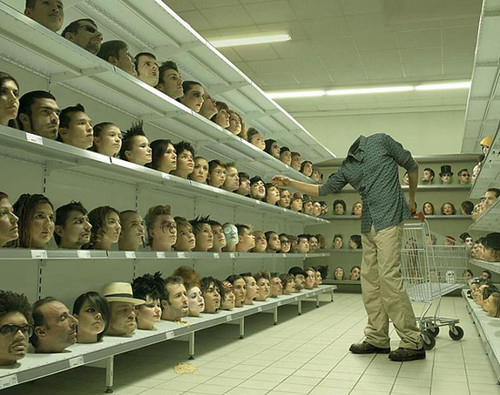
Creative Photoshop

Speaking of creativity...

...check out this link that shows some outstanding work in Photoshop with some whimsical creativity.

http://pelfusion.com/inspiration/50-amazing-examples-of-photo-manipulation/

Example above created by Christophe Huet.
Check out his photo stream on Flickr.
.
.
.


What They're Saying About Creativity

Continuing on my latest posts about creativity, here are some quotations to help you further consider what creativity is:

To live a creative life, we must lose our fear of being wrong. (Joseph Chilton Pearce)

Do not fear to be eccentric in opinion, for every opinion now accepted was once eccentric. (Bertrand Russell)

Discovery consists in seeing what everyone else has seen and thinking what no one else has thought. (Albert Szent-Gyorgi)

The diversions are what dial up your ability to see patterns between things. Creativity is the observation of patterns. (Richard Wurman)

The things we fear most in organizations--fluctuations, disturbances, imbalances--are the primary sources of creativity (Margaret J. Wheatley)

Creativity...the power to connect the seemingly unconnected. (William Plomer)

Creativity is the ability to introduce order into the randomness of nature. (Eric Hoffer)

Creativity is piercing the mundane to find the marvelous. (Bill Moyers)

Clang Delta - Get Creative

Clang Delta

Bonnie's 10-Step Program to Creative Thinking

Create solely for the joy of it.

Let curiosity drive you.

Abandon your need to fit in.

Nourish the child in you and let this child come out to play.

Give yourself permission to be eccentric, even outrageous.

Dismiss the judge in you that sets rules and boundaries.

Experience something new each day.

Look at the world as if you were an ant, egret or alien.

Take time to vegetate without being afraid you are wasting time.

Ask what if.

(Also posted at Will Walnut's site here.)

© Bonnie J. Schupp

Creativity and Education

Last week I attended a seminar at AVAM on Arts, Creativity & Outrageous Education Ideas. It confirmed that much of what I did before retiring as a teacher was effective—when I was given time to teach creatively and include the arts. Here are just two examples:

Music in Language Arts Class

During our 7th grade literature unit that included medieval legends, students were responsible for research and then presenting a special project. Being familiar with Gardner’s multiple intelligences theory, I liked to give students choices of how to present their research to their class. With some units, they created games or puppet shows. Other times they created books or posters.

One of the project choices in the medieval legends unit was to focus on medieval music and to present it in some way to the class. In one class, one boy worked on music. He was a problem child in a number of ways. He was disruptive by antagonizing his fellow classmates. The more they tried to bully him, the more he encouraged it. Of course, I tried to stop it in my classroom, but I’m sure things happened out of my sight.

This boy asked if he could bring in his piano keyboard when it was his turn to present medieval music and I said yes. Something happened in the dynamics when he presented. Instead of playing the role of a bullying victim, he became a teacher. He taught them what he’d learned in his research and demonstrated it with his musical skills.

The class was in awe and asked him many questions afterward. One student summed up the changed this way, “I always thought you were just a nerdy loser. I didn’t know you were so cool.”

Who Am I?

Several years ago while I was still teaching, a former student came to me during Back to School night. He asked if I remembered him. This young bearded adult resembled no twelve-year-old I had taught and I asked his name. This I did remember when he told me his name. I remembered also that he had missed a lot of time from school.

That night he told me that he'll always remember my class, that it was his favorite. Since he had failed my class in spite of all the strategies I tried, I was flabbergasted to hear this.

Out of curiosity, I asked him what it was that he remembered about my class. He said it was the hero/monster book project assigned in my 7th grade class. He told me he still had the bound copy of his group's book and that it was one thing that he really enjoyed in middle school.

Beowulf and Monsters 

That year, after reading a modified version of Beowulf, I had divided each class into groups of four for a special project. Each group was responsible for working together to create a book which would have an original hero story that included a monster. Students were given instructions to include specific elements in their story. Besides the illustrations and main story, other elements included book jacket information, table of contents, and an interview with the Grendel’s mother. (Grendel and his mother were monsters.)

This project, truly an activity which reflected the critical thinking that should be taught in every classroom had captured this former student's imagination. I'm sorry to say after that year, I no longer had time in the curriculum to include this project. It took too long and I would not have had time to do the required teaching for the MSPAP tests. I was responsible for teaching the test jargon and strategy, giving practice tests, doing unit assessments for five classes—over and over again until it was time for the test.

Connecting With School

There was no time for the creative book project. And even so, the time it would have taken to work on the group projects and print and assemble the books might have been in vain anyway because my copy allotment would probably have run out with making so many book copies for the students.

There was no time to teach in a way that I knew turned kids on and connected them with literature, writing and school.

Imagination 

Albert Einstein said that "imagination is more important than knowledge" but those who power the educational system policy must not have discovered this yet. Could it be they lack the imagination to envision what the education of our children could be?

The student who visited me years later during Back to School Night understood the importance of imagination.


Creativity - How Ideas Happen


Birth of Ideas


Fertilize the Mind


How is an idea born? Paradoxically, the answer remains an enigma even to those who spend their lives creating ideas.


Designers who talk about their creativity in the book, A Smile in the Mind, by Beryl McAlhone, all work with basic elements of the creative process: fluency, the process of developing a multitude of ideas; flexibility, the ability to see different approaches; originality the result of new combinations; and elaboration, building on these ideas. However, none of these designers can concretely explain how original connections happen. There is no road map, no template to follow. Instead, people use various techniques to fertilize the mental ground where these ideas grow.


Getting Started


Like many designers, Milton Glaser starts with words and, as in any communication process, he begins with what the audience knows. He uses familiar clichés as the medium to establish the context. However, this is only the beginning of the process. "You must use clichés to set the stage and then twist it in such a way to disrupt it." Once the audience recognizes the cliché, the context, then the cliché needs to be "detoxified." Glaser discusses the importance of shaking up expectation. He says the successful execution of wit is the "penetration of the immunity of an audience." When the cliché they understand does not follow through in the expected way, it breaks through the immunity. This wit is what people remember.


There are a number of creative "models" (CPS Model, James Higgins Model, de Bono's Six Thinking Hats, etc.) which attempt to be templates for the creative thought process. Glaser, however, talks about how creativity is not a rational process. You cannot generate ideas if you are traveling a linear path. Often ideas are born not only off the path but also on different levels. Picture an idea as a living thing meandering on a flat piece of paper on a desk. In this scenario, there is a limit to where the idea may travel.


Now picture an idea meandering in and out on the crinkles of a balled up paper, taking flight on a ribbon of steam from a coffee cup, grabbing the sound wave of a ringing phone and then hopping back on the ball of paper. Infinite possibilities abound on this second journey. The important thing is to keep an open mind about how and where ideas may travel.


Be Ready


Some people use certain mechanisms for triggering ideas, such as talking with others, starting something new, sleeping, smelling apples or walking. I find that most of my ideas come while walking or driving. Usually when I walk, I carry pen and paper to jot down ideas before they are lost. On several occasions, while driving I've become so wrapped up in the flow of ideas from so many directions that I have wound up lost in a stranger's driveway. Glaser suggests that ideas happen when you allow yourself, in a relaxed state, to go off on tangents. Most of the designers in this book say their ideas come when they are not thinking about the project. They allow the subconscious to work and make connections. Bill Moyers reminds us that you must "pay attention to your preconscious self that slips messages to you, much as a note is slid under the door."


Glaser says it helps to place yourself in a state of readiness. In order to discover concealed relationships, you must be ready to accept them. This cannot be willed. "Ideas happen when you release your mind from its willful demand for something to happen." You cannot insist on getting an idea, for instance, by four o'clock this afternoon. I've always understood this. As an undergraduate student at Frostburg, I became upset when my creative writing teacher announced that we would take a creative writing exam at a scheduled time. Creativity does not happen by arriving at a two o'clock exam and following a prompt to create on demand. I took a big risk and protested this philosophy. I showed up at the scheduled test time, ignored the creative writing exam, and wrote about why I was refusing to take the exam and how I perceived the flow of the creative process. What I wrote must have made sense to the professor because I received an A for the course.


Filling in the Spaces


Finally, Glaser looks at design as narration and suggests that the most important element is what is left out. It is important for the viewer to complete the communication by connecting with what is not said, with what is not shown. This pulls the audience in as collaborators in the creative process. Many teachers complain about the lack of student imagination and creativity. David Thornburg calls creativity the "new scarcity" in educational institutions and Jonas Salk says our future depends on creativity. Perhaps today's students may not be challenged enough to fill in spaces. Audience participation might also be the reason why reading a book is almost always better than seeing a movie. The reader must fill in more spaces when reading, while movies tend to complete things for the viewer. When the audience participates, there is an intrinsic sense of satisfaction in making the connection. And often this connection does not stop with the "aha" moment. The audience not only remembers the message, but also uses imagination for further elaboration of their own.


It is the process of filling in spaces, putting yourself in a state of readiness and giving yourself permission to meander that fertilizes the mind for creative growth. You may be unable to describe the birth of an idea but you can certainly put out the welcome mat.


© Bonnie J. Schupp


Creativity - AVAM


AVAM, the American Visionary Art Museum in Baltimore, is a celebration of creativity. Rebecca Hoffberger, its founder and director, joyously embraces creativity and all those who open themselves to its possibilities. My husband David and I are AVAM members and we share Rebecca’s spirit.


Mind, Brain and Education


Today I attended one of many events at the museum, a seminar entitled “Arts, Creativity & Other Outrageous Education Ideas!” This was in conjunction with the Johns Hopkins University School of Education Neuro-Education Initiative and Council on K-12 Education’s “Learning, Arts and the Brain Summit.”


Although I’m retired from teaching and this program was presented to a room full of teachers, I continue to hold an interest in learning and creativity. So I attended and I’m glad I did.


As I listened to speakers Jerome Kagan from Harvard University, Alice Wilder who is producer of Blues Clues, Keri Smith who has written several outrageous creativity-oriented books and Kathy Hirsh-Pasek from Temple University, I felt good about the way I integrated the arts into my language arts curriculum and the reasons for doing this.


Intrusion of Testing and Content Alone


I can’t say that I did much of this during the last two years of my teaching career, however, because teaching by that time was confined tightly to teaching the language of the standardized tests, practicing for the real test over and over again, assessing the practice tests and then taking the tests. There just wasn’t time to do much of anything else. (You can read unorganized thoughts and rants I wrote while teaching.)


Jerome Kagan passionately made a case for teaching the arts. He spoke about cutbacks in recent years and how this has affected us as a society. He said that without the arts, “subjective feelings become subordinate to logic” and there is a “growing reluctance to anger any group.” You see, arts has to do with pushing boundaries, angering people and making us thing. Without the arts, our school children and their teachers live in a small corral with tight boundaries. This is not conducive to learning. It is not conducive to risk-taking, exploring and making new discoveries. “we’ve upset the balance between correct and intuitive.”


Kagan reminded us of the need for a vacation from the correctness and rank that has been imposed on us.


Keys Changing Hands


Kathy Hirsh-Pasek, professor of psychology at Temple, talked about how the “arts and playful activities create opportunities that are pregnant with learning.” She quoted from Daniel Pink in talking about the future of education, “The keys to the kingdom are changing hands toward empathizers and creators.” Things are changing. Needs are changing.


Hirsh-Pasek listed the skills that will be needed for the future—skills and opportunities that we should be providing for students:


  • collaboration
  • communication
  • content
  • critical thinking
  • creative innovation
  • confidence (to take risks)

Alice Wilder, producer of Nick Jr.’s Blues Clues talked about the importance of engaging children with learning and showed examples through Blues Clues, Super Why, and Think It, Ink It, an innovative approach to help children imagine and write books.


I was intrigued by Keri Smith’s talk. She spoke of her disenchantment with school, while at the same time finding creativity when she stayed home. She told of the rewards of risk taking. She shared with us excerpts from her books, Wreck This Journal and How to be an Explorer of the World—truly wild and innovative approaches to creativity. Check out her website to explore some of her ideas.


AVAM


If you haven’t seen the latest exhibit at the American Visionary Art Museum, it’s well worth spending several hours exploring The Marriage of Art, Science & Philosophy. As Rebecca says, "It is a dance between imagination and reality." She also reminds us to find the extraordinary in the ordinary. You’ll find it at AVAM.


Happy 90th Birthday ...

...Pete Seeger ! Read Marc Steiner's blog on Pete Seeger.


Listen to Seeger singing his famous song Turn, Turn, Turn.

Have Piano, Will Travel

Enter strangers, leave friends...


Thirty years ago, I opened my home to strangers from all over the world. Likewise, around the globe, people I’ve never met have invited me to stay in their homes. I do this because of a belief in the importance of connections to overcome prejudices and fears. It has been a step toward creating a wonderfully rich life. Part of the richness of my life is reaching out to people who seem to be different from me and then discovering we’re not so different at all.


Today, the traveling piano man, Danny Kean, and his dog Boner just left after staying six nights at our home. My husband David and I had never met him but when he e-mailed me about staying for two nights with us, I told him more than two nights were fine.


And I’m glad he stayed longer.


Danny sold his house and leaped big-time into uncertainty. Most of us are afraid of uncertainty, otherwise we wouldn’t be afraid of death. Confronting uncertainty and immersing himself in the present, Danny has taken a leap of faith that the path he has chosen will continue to enrich his life as well as others.


He travels with Boner next to him and a piano on the back of his red pickup truck. During the day, he stops here and there and brings a gift of music. It might be in a park or on a street corner. It might be on the beach or in front of your house.


A gift of music and Boner too


The gift of music is not merely his piano playing, although he belts out a fantastic rendition of Nola and various high energy ragtime music and soothes the soul with free-spirited improvisations. His

gift is empowering others with creativity and music they may not have known they had in them.


You see, when Danny pulls his truck over, he invites people to his truck. Part of his gift is Boner too. Danny wants the world to meet Boner who is more than 14 years old and who perches on tops of the piano on the truck bed. Boner greets curious visitors who approach and seems perfectly content to be part of this music experience.


Danny invites people to climb aboard the bed of his truck and sit at his piano and play. Most people are shy and are reluctant to do this, probably because they feel they can’t play the piano. Before you know it, Danny has talked them into playing. With gentle persuasion, he encourages them. He says that even one note is music. Then he tells them he’ll count to 60 and they should play until he gets to 60. He counts quietly out loud and somehow untrained fingers begin to create music.


I saw a young woman on her birthday, who reluctantly sat down and played while her three children listened in surprise. I saw a young husband and his pregnant wife play together for their unborn baby. These people had no training but you could see the change in their faces as Danny allowed them to be free, encouraging them along the way. He empowers people to get in touch with themselves through music.


We’ll miss Danny and Boner and their special magic and hope they’ll visit us again.


Servas


I haven’t answered the question about how we go about meeting these strangers all over the world. Thereare three organizations that we’ve had experience with: Couch Surfing, Hospitality Club and Servas.


We’ve had the most experience with Servas which was founded in 1949 by Bob Luitweiler and some friends who envisioned a grass-roots movement toward world peace by people opening their homes to one another. We’d just experienced a second world war and it seemed we couldn’t depend on our leaders to prevent a third world war. It sounds idealistic and perhaps it is, but it works for those who are open to this experience.


I like to tell people that I used to look at a map and see only names of places. Now, after 30 years with Servas, I look at a map and see names of places where my friends live.


Travel is fatal to prejudice, bigotry and narrow-mindedness, and many of our people need it sorely. Broad, wholesome, charitable views cannot be acquired by vegetating in one's little corner of earth. (Mark Twain)


~ ~ ~ ~ ~ ~ ~ ~ ~ ~ ~ ~ ~ ~ ~ ~ ~ ~ ~ ~ ~ ~ ~ ~ ~ ~ ~ ~


Highly recommended reading


David's compelling article about The Sun's latest round of lay-offs.


Defining Ourselves

For two years, I challenged people to answer this question: How do you define yourself? I asked people to respond in one sentence of any length beginning with I am... After they answered, I photographed them to illustrate the self-definitions. I received nearly 100 responses from people ages 4 to 100 representing 15 countries. Participants are diverse and include a Holocaust survivor, transgenders, gays, lesbians, a pilot, a police officer, poets, musicians, Muslims, Jews, Christians and athesists. Some people are well-known in their fields but most are not in the public eye.

During those two years, the project took on a life of its own. Perhaps it is best said in an African proverb: We are because I am. I am because we are.

Below are photos of my response and that of my father who was the inspiration for this project, and the talk I give about this two-year photo/word project.


Defining Ourselves

A two-year international and multi-generational photo and word project examining who we are

Background

It’s funny how small things can grow. Take words, for example. Off-hand words are not usually meant to inspire or start anything. but it is what the listener does with the words that plants a seed.

This is what happened to me.

My father has Parkinson’s disease. One day, he was trying to perform an ordinary everyday action and, frustrated with a shaking hand, he said, “Bonnie, this isn’t me.”

Hearing those words awakened something in me and I wondered how he defines himeself. Then I wondered how I would define myself. The seed was planted and it grew.

Beginnings

I spent the next two years reaching out to family, friends, acquaintances and strangers, challenging them to answer a question that goes to the core of their being.

The challenge question was this: “How do you define yourself? Answer in one sentence that begins with ‘I am...”

Some people I asked had never thought about who they are on any level of depth. Like many of us, they habitually go about their everyday lives, bobbing along on an ocean of chores and necessities.

Some people wondered why I was asking this question at all. Good question.

My answer? I believe that in order to appreciate the past, live in the moment and approach the future, we must have an understanding of who we are. And, in order to connect with our world—our environment, other people and our own spirits—we have to examine ourselves at our core. If we are unable to wrap ourselves around our own self-definition, then our lives and connections fall short of what is possible.

Defining Myself

Before asking anyone else to answer this question, I knew I had to take on the task of defining myself.

After much thought, this is my self-definition:

I am a child of the universe who lives a rich life
of creativity, connections and possibilities.

I said child of the universe... child, yes, because I wonder, explore, feel, grow, find delight, learn, walk daringly into emotional minefields — all in a setting of naiveté, trust and optimism. Yes, a child’s point-of-view.

Of the universe suggests my membership in something larger than I am.

In considering the rest of the definition, I thought about what elements of my life, if they were to disappear, would cause me to feel less alive. The answer? I must create and I must connect. My creativity can take many forms.

My connections are with people , environment and spirit.

Possibilities...suggests growth, adventure, change. If we ever lose our sense of possibilities, then we are in the process of dying.

Finally, I consider my life to be rich because of shared energy in all its facets. It is a layered life rather than a linear one. Underlying my definition, my essence, is a broad sense of love.

So, my definition does not depend on my job/career and it doesn’t necessarily depend on my health. I can still be who I am...regardless.

The Process, Considerations

Once I had my own definition, then I could begin asking other people to define themselves. It started with family and friends. Then it extended to friends of friends and sometimes strangers who I approached with this question. Some never answered while others were intrigued by the question.

One thing I stood firm on. I refused to share anyone’s answer with those who were still struggling to find their own. This was uncomfortable for many. They wanted sample answers. They wanted to make sure they answered correctly and in the way I expected. My only condition was it had to be one sentence, of any length, that began with “I am.” I assured people that there were no right or wrong answers unless they didn’t follow those two conditions. Whatever they said would be correct because they were defining themselves and they knew themselves better than I did. Who was I to say they were wrong?

After I received each response, I then shared other answers and portraits. We scheduled a time to do a collaborative portrait that illustrated the self-definition. Logistics were difficult because people were spread around the globe. I made a 600-mile detour to Indiana to get one portrait. For another I flew to California and for another I drove to upstate New York. Some were taken in Japan. One problem I hadn’t anticipated was the difficulty there would be in scheduling time for the portraits. We’re talking about busy people. And some had the idea that this was a small on-going project with no end. They kept saying, “One day we’ll get together to do this.”

A few people responded through e-mail but, because of distance and time, we were unable to connect for a portrait.

Once time was scheduled, then we usually worked together to come up with the concept. As a photographer used to doing my own thing in my own way, this was a different kind of challenge for me. There were two of us working on the portrait. Some people were uncomfortable with showing their faces or being in front of a camera lens at all. I didn’t want to use anything that made someone uncomfortable but, at the same time, I insisted on remaining true to my concept. (If you want to know more about technical details such as camera, lights, etc., you can talk with me later.)

In spite of all the challenges, somehow, over the course of two years, this project has come to fruition. Amazing.

Answers have come from people ages 4 to 100 representing 12 countries. Responses include a Holocaust survivor, transgendered people, gays, lesbians, an airline pilot, Arabs, Jews, Christians. Most participants are not in the public eye – just ordinary people. However, some are known locally and internationally.


The Responses

It fascinates me how people answered this question.

Of all the responses, 24% include career and hobbies in their definitions. Of course, this is not surprising. Consider how many hours a typical person might work at a job/career in a lifetime. Probably more than 93,000 hours, considering working ages 20 to 65.

Twelve percent mention God, spirit or the divine. This includes a wide range of believers and non-believers from various religious backgrounds.

And don’t forget love. Fifteen percent of those who responded to my question have “love” or a form of the word in their definitions. Petronio Bendito says it best in one of my favorite responses, “I am all that I love.” Many self-definitions made me think, but this one the most.

It is most significant that almost half—42%—defined themselves by their relationships. The percentage is even higher when you consider the definitions that imply relationships. This is the area of greatest similarly among respondents. I don’t think anyone would dispute the importance of relationships and how they lead us to new emotional places and better understanding of who we are.

Fred Muir, a Unitarian Universalist minister who participated in this project, puts it succinctly in his self-definition, “I am my relationships.”

It is noteworthy that most people did not define themselves by their nationality or race. Nine percent included age or age-related terms, the majority being young people. Thirteen percent used gender as part of their definitions but none of these were the two transgendered participants.

I find it interesting that 12% expressed a dichotomy, a feeling of the complexity and tug and pull of their being. How often have all of us felt fragmented and torn? How many of us sometimes do battle inside ourselves when making decisions? Recognition of this dichotomy is recognition of our full humanness. Joe Justice, police officer, said it well, “I am simple and complex, logical but emotional, aware yet eternally ignorant, powerful although miniscule—all of these dichotomies because I am human.”

In defining ourselves, there is a consideration of time. Ten percent connected in some way with time... past, present or future. Dirk Hamilton’s, the shortest definition, states simply, “I am here.” However, it is a deceptively simple answer. Those words imply that he embraces and lives in the present, an important tenet of Eckhart Tolle’s book, A New Earth where he says, “People who are able to be present in the now are closest to the essence of their true being.”

In President Carter’s famous “malaise” speech, he pointed out, “Human identity is no longer defined by what one does, but by what one owns.” It is heartening that not one person in this project sought identity through ownership.

Seven percent of the people who responded to my question recognized an evolving self. For some, including my husband, before defining themselves, it was important to understand that who they are today may not be who they are tomorrow. A former student of mine, Justin Wainio, defined himself with this contradiction in mind, “I am always changing while always staying the same.” Anais Nin has an interesting comment in her diary. She says it’s impossible to define yourself because of possibilities. “How can I accept a limited definable self when I feel in me all possibilities? ... I never feel the four walls around the substance of the self, the core. I feel only space.” 

In fact, five percent mentioned “possibilities.” This perspective looks forward into the future for what can change, what can be and who we can further become. There is an openness in those who included “possibilities” ... an openness and acceptance of the evolution of “becoming.”
 
Final Thoughts

This has been a difficult but exciting journey inspired by my father’s comment and it grew into something much larger than I’d anticipated. I learned from everyone who answered and I discovered something part way into the project. This whole thing is not really about me or any one person. It’s about the you and me that makes up the we. Over the past two years, it has taken on a life of its own and I no longer own it. It is ours. Perhaps it is said best in an African Proverb:

We are because I am. I am because we are.

Bonnie J. Schupp

How do you define yourself?


Defining Ourselves

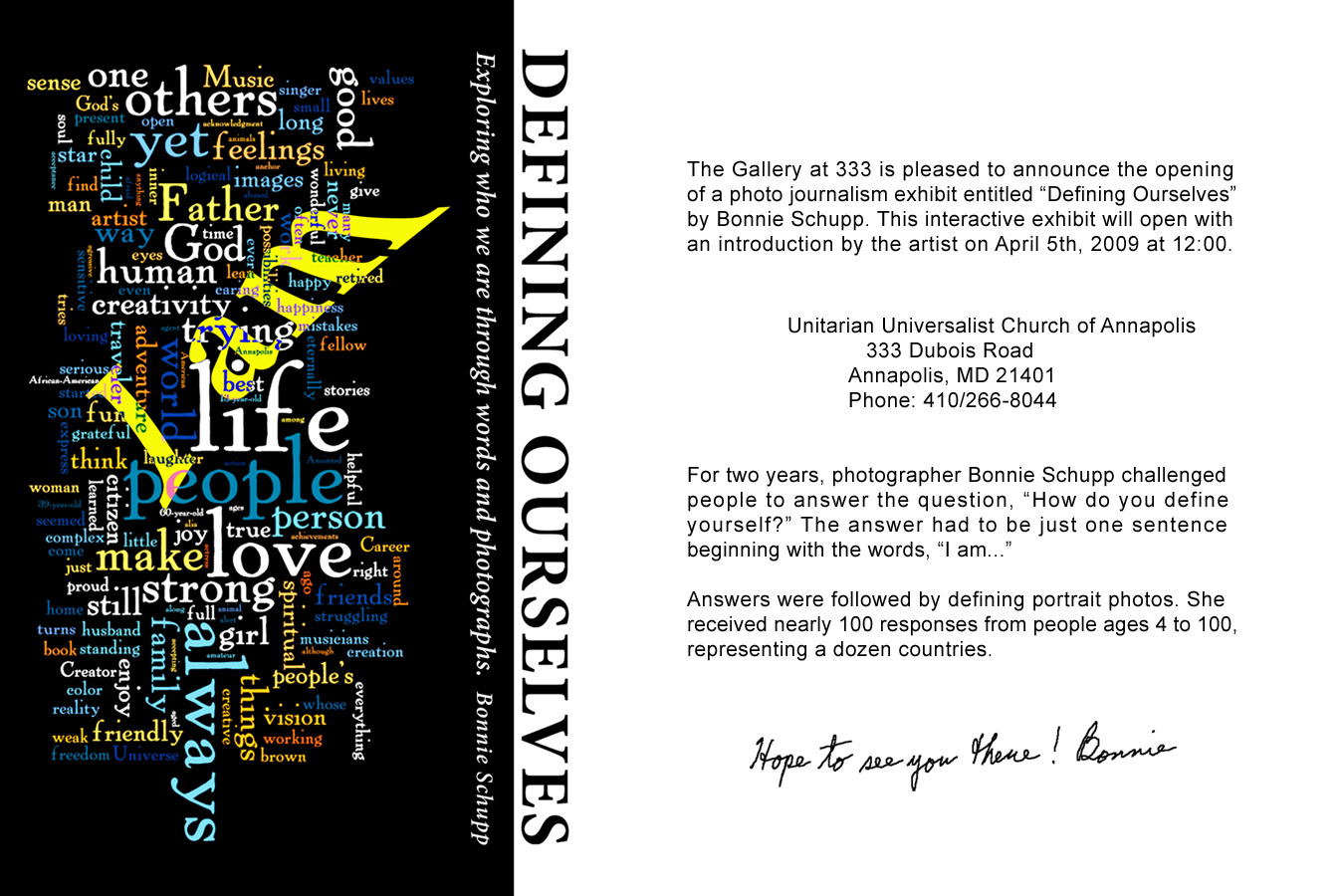
For two years, photographer Bonnie Schupp challenged people to answer the question, "How do you define yourself?" The answer had to be just one sentence beginning with the words, "I am..." Answers were followed by defining portrait photos. She received nearly 100 responses from people ages 4 to 100, representing a dozen countries.


Exhibit opening: Sunday, April 5, 12 - 1:30 p.m.

333 Gallery
Unitarian Universalist Church of Annapolis
333 Dubois Rd.
Annapolis, MD 21401