Dr. Bonnie J. Schupp, retired educator, taught in
Baltimore City, Annapolis and Pasadena, Maryland.
 |
| Youth Dreamers display at Artscape © Bonnie J. Schupp 2014 |
Trends come and go
Sadly, our culture has become
one with short-attention spans spurred on by technology of limited character
tweets and television styles catering to a focus limit of 1 ½ minutes. I
see this in the field of education also with policy makers. Every 5-10 years a
new educational trend explodes—and then disappears quietly. Remember those
students who were not taught phonics but rather whole language alone? Remember
learning centers? Remember cooperative learning, the comprehensive (bigger)
high school model, A Nation at Risk Effective Schools, Madeline Hunter’s SPONGE,
Standards Based Education, and schools within schools? Now we have Common Core. There has always been
and will always be endless streams of new initiatives in public schools.
By the time I left education, teachers had to write
the class objective (in educational terms) daily on the board, students read it
at the beginning of the class and then repeated what they learned at the end of
class. Just before I retired in 2003 to complete work on my doctorate, another
disturbing trend was on the horizon. Middle school students did not understand
how damaging a zero could be to their average. (Every year I always spent a half hour
at the beginning of school doing math with my students to show what happens.) According to the school system,
the solution was that teachers could not give a grade below 50 to students,
even when they failed to do the work. Needless to say, a subtle negative message goes out to students when they get credit for doing no work.
Those who lead education
always seem to be wearing blinders. They see in a narrow and shallow way that
limits their understanding of the breadth and depth needed to educate children.
Contrary to Bush’s No Child
Left Behind (NCLB) and Obama’s Race to the Top, there are no quick fixes in
education. It is incredible that so many people believe that we merely have to
raise standardized test scores by a certain date and everything will be okay.
Even more incredible, they believe that teachers bear all responsibility for
fixing things and that they should be rewarded or punished based on the test
scores of their students.
(Read this humorous piece about what would happen if we held dentists responsible for their patients' cavities: http://bloomingjourney.blogspot.com/2002/02/httpwww.html )
There is no shortage of
articles and books about what is wrong with American public schools and I will
include links at the end of this blog. Bottom line is that trends come and go,
many fail, and our students could be more successful if teachers were just
allowed to teach.
Today, standardized tests are
driving curriculum and our children are the losers. When I won a Fulbright Memorial Teachers Fund trip to Japan and
visited classrooms there, I saw the effects of a test-driven curriculum. Japanese students were tested only on reading and writing in their English
classes. Since spoken English was not tested, they were not taught much spoken
English. Even some of their teachers could not speak much English. It is
interesting that Japan and the United States seem to be switching approaches to
education these days. We are focusing on tests while they are changing focus to
the whole child.
Teaching before the test worship
I am disturbed about the
trend to eliminate certain subjects that do not relate directly to the tests.
People who are not teachers and who are driving education reform do not see the
big picture. School subjects overlap and reinforce one another. For example, one
of the novels I taught in 7th grade was The Cay by Theodore Taylor. These are just of few of the skills and
concepts I covered, often skills that are focused on in other subjects:
- Reading and drawing maps; creating and interpreting
symbols
- History – World War II
- Global cultures
- Cause and effect
- Point-of-view
- Empathy
- Finding patterns
- Summarizing
- Vocabulary
- Connotation and denotation
- Meaning in context
- Survival skills; prioritizing
- Weather
- Punctuation
- Music
- Main idea and supporting details
- Predicting
- Figurative language
- Inference
- Connection between setting and characters
- Story structure
- Dialect
- Multiculturalism
- Reasoning
When we completed our study,
the elements of Bloom’s taxonomy (knowledge, understanding,
application, analysis, synthesis, evaluation) had been incorporated into student
learning. My students received an education with breadth and depth.
The newest educational trend today is Common Core. I have no problem with
setting standards, benchmarks of learning for each grade. However, as usual in
education, a good idea becomes distorted when it is implemented. There is a lack
of emphasis on social studies and science. Common Core language arts lessons are
structured for each day of a six-week unit. On paper, some of it looks
good. In practice, there are glitches—special student needs, fire drills,
absences, classroom fights, special school functions and more. I may be wrong,
but it appears to be strictly scripted with little flexibility for spontaneity
and creativity that promise to connect students with learning in meaningful
ways.
How does testing hurt our children’s education?
This answer was clear to me
close to the end of my teaching career. We teachers had to teach for the tests. When I began teaching in 1967, I floundered
the first year and then, with practice, became a better teacher. After teaching
in Baltimore City, Annapolis and finally in Pasadena (Maryland), I had become a
more effective teacher than when I started, but by the time I retired, I had no
time to put my skills into practice. The joy of teaching had been replaced with
teaching for standardized tests.
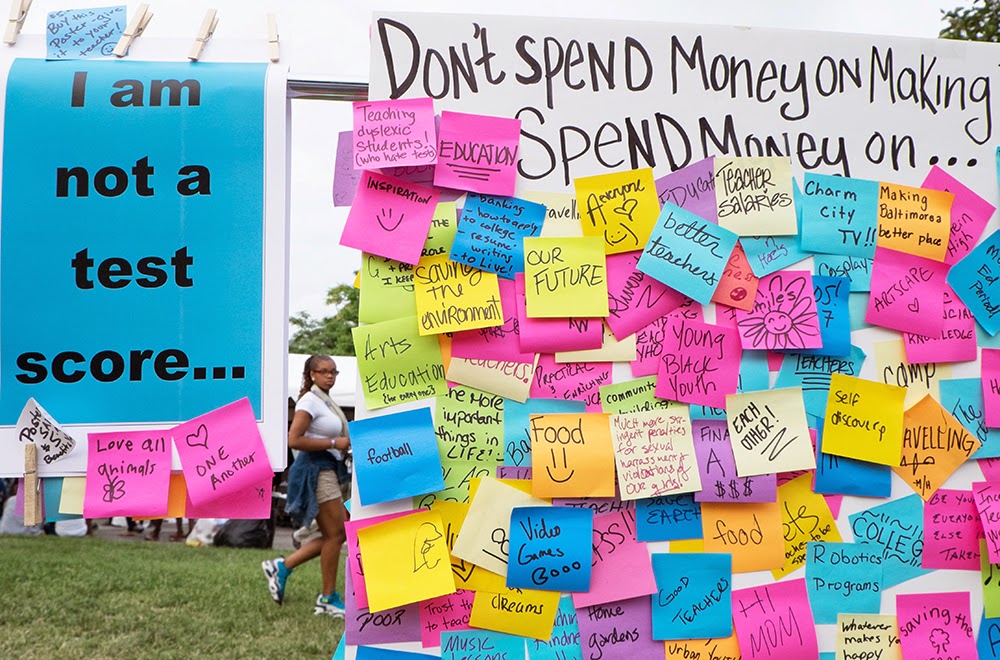 |
| Youth Dreamers display at Artscape © Bonnie J. Schupp 2014 |
This test focus results in:
- loss of in-depth instructional time in the class
- removal of curriculum/classes that are not part of the
testing program
- millions of dollars spent on testing when that money
could be more effectively used for real education
- loss of the joy of learning
- misleading assessments of learning
- teaching children to be good test takers rather than
educating them
- the belief that test scores tell all
When teaching was fun and successful
Before the testing craze, I
taught a unit on heroes, which was part of the 7th grade curriculum.
It involved teaching reading and writing skills through literature, non-fiction
and fiction. The first lesson involved trying together to define what a hero
was. Such a fun lesson. My students read stories of real-life heroes from all
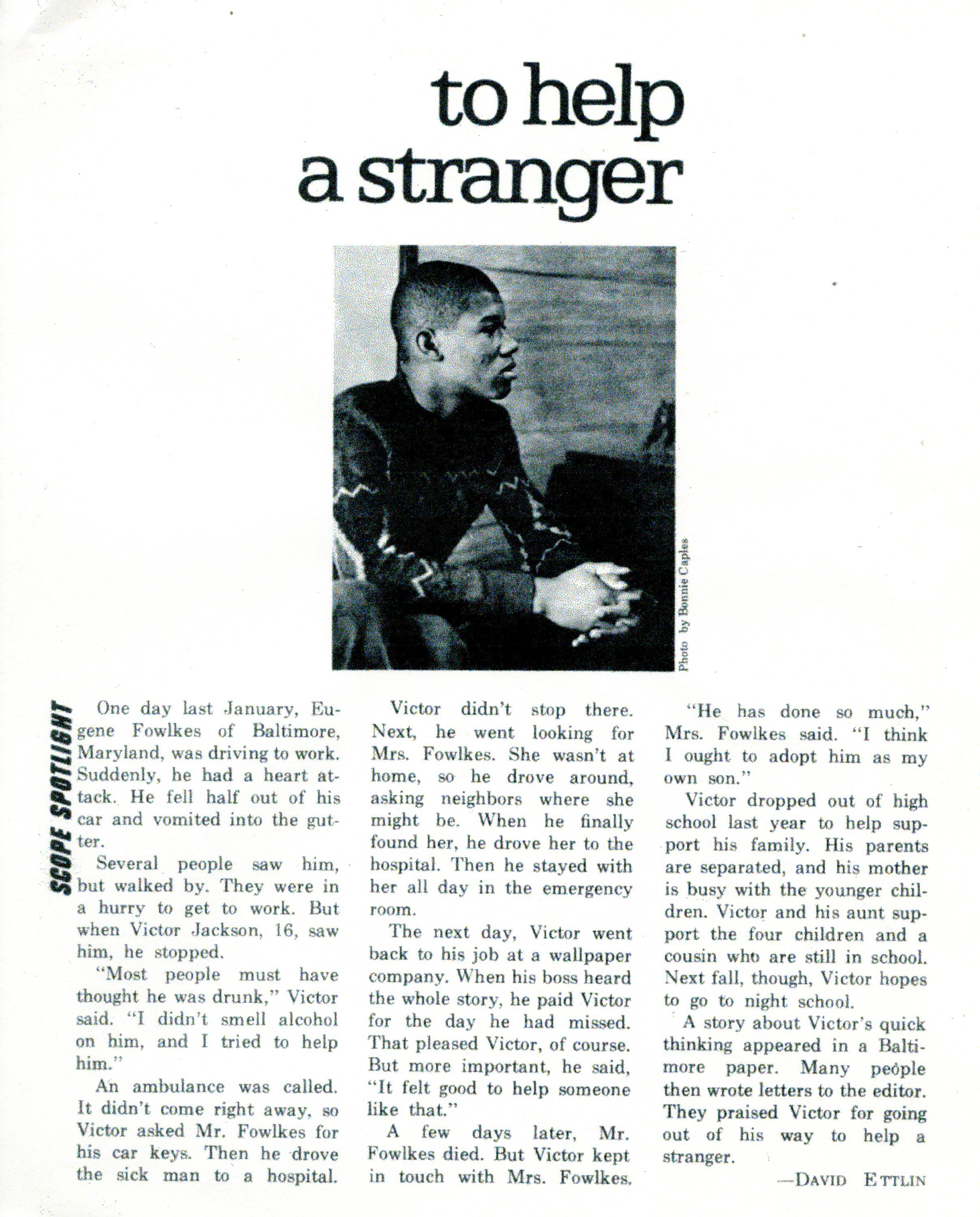
cultures. I used newspaper articles. Through role-playing, I introduced the good Samaritan concept and shared a Scholastic Scope article for which I had taken the photo many years ago. It was about an inner-city youth who might
have been considered a good Samaritan, maybe a hero. http://bonnieschupp.com/Victor.jpg
One of the available novels
for this unit was an age-appropriate version of Beowulf. It offered a platform
for teaching many reading and writing skills and some great thinking skills
too. Good versus evil. Monsters. Bloody fights. These things captured my middle
school students but there were many subtle things that I taught. Students were
saying, “Yea, Grendel, the mean monster was killed.” We could look at the issue
of bullying. We could also address empathy when Grendel’s mother took revenge for
her monster son’s murder. We discussed how she must have felt and students had
to write a piece from the mother’s perspective. One of my 7th-grade
students (he had failed twice and should have been in 9th grade)
told me that this was the first book in his life that he had ever read through to the end.
“Tell me a fact and I’ll learn. Tell me the truth and
I’ll believe. But tell me a story and it will live in my heart forever.”—Indian Proverb
Also, with this unit, my students
produced original books. I divided them into carefully selected groups, keeping
in mind each student’s strengths and weaknesses. I gave them specific
instruction as to what elements had to be in this book: a story of a hero who
fit into the definition of a hero that we had come up with, illustrations, bios
of the students in the group who produced this book, etc. When they finished, group members received copies of their book. It was a lot of
work as a teacher—and an exhausting process—but I did it because I witnessed my
students’ enthusiasm as they learned and grew.
Years later, when teaching
for the test mandated that I drop this activity, a young man approached me at back-to-school night.
“Hi, Ms. Schupp, do you remember
me?”
From the beginning of 7th-grade
to the end, students change so much that they often look like different
children. It had been several years
since I had taught him.
“You look a lot different
now. I’m going to need some help.”
“John _____. Ms. Schupp, your
class was my favorite.”
Yes, I remembered him. His
attendance record had been poor and led to his failure in my class. Yet, my
class had been his favorite?
“I’m glad to hear that. Why
was it your favorite?”
“Remember those books we made
in your class? Well, I still keep it in my room and read it now and then.”
In today’s punish-the-teacher-for-student-failure culture, I would be considered a bad teacher. After all,
this student (who seldom came to school) had failed my class. However, my class
had been his favorite and I succeeded in making him proud of one of his
accomplishments. This is only one thing that standardized test scores do not
measure.
Also, along with this heroes
unit, the other 7th-grade language arts teacher and I included a
medieval feast day because we had read about King Arthur in a historical setting.
Students were assigned research topics to help them prepare for this special
day: medieval clothing, food, games, beliefs, customs, castles, music.
Then on the big day, during each class period, we met in the “banquet hall”
(the school’s multi-purpose room), did role-playing with royalty, jesters, costumes,
food, music, games. We usually had more parents who helped with this event
than who showed up on parent conference day. Educational? Yes. A success? Yes,
on many levels.
When testing became the
focus, there was no longer time for this event.
 |
| Youth Dreamers display at Artscape © Bonnie J. Schupp 2014 |
The trouble with tests
Besides being limited in what
can be assessed, test culture takes money away from other areas that
count. Testing is a moneymaking industry: producing tests, tutoring, testing
services, new textbooks and more.
Tests do not give a complete
and accurate picture and they are not used effectively. Furthermore, students are not held
accountable. The tests aim at basic functional skills while we should be aiming
higher. Most are given during the school year with results coming back so late
that current teachers have no time to respond to them in instruction. They do
not take into account student motivation. I observed close hand how my students
responded to these tests and many put in little or no effort. Middle school
student thinking is askew at that age. Some who dislike their teacher will
actually make no attempt to do well so they can “get back” at their teacher. After
all, students have no consequences for their test scores.
Parents also have no
consequences. Some 12-year-olds get themselves up and “ready” for school. Some
parents have no parenting skills. I have observed parents picking their
children up from school, smoking, and handing over a cigarette to their
children. Sometimes, parents would show up at school to continue fights their
children got into with other children. In some cases, education is devalued. In
the middle of the school year, parents take their children to Disney World for
a week at a time. Never mind that important skills are being taught in class
that week. They ask teachers to send home worksheets a week ahead so, between
Space Mountain and Jungle Cruise, their children can quickly fill in answers.
Teachers should never be
rewarded or punished based on student test scores. Although a teacher is
important, there are too many other factors that play a part.
Learning the buttons but not getting it
In photography, a person can
learn all the buttons on the camera, navigate the digital menu with skill, take
a perfectly sharp and exposed photo, ace a photography test BUT still be a
mediocre or poor photographer.
Education, whether it is
learning how to take photos or learning school subjects such as math, English,
social studies or science, is about more than learning facts. These isolated
facts must be connected with living and all the emotional layers that make up
life. They must connect with communication with yourself, your world and
others. If education does not venture into these less obvious areas, it is a
skeleton with no place to go except the grave.
A certain spirit must drive
true education.
No instant gratification
Learning is a long and
difficult process with incremental improvements over many years. It is
complicated and lives in many layers.
Problems in education cannot be fixed in one or even in five years. Some
shallow thinkers believe we can reward and punish teachers and student test
scores will go up. Not everything is based on teachers’ skills. The education
of a child is complicated and solutions are multi-faceted.
Students do not come to the
classroom as empty vessels ready to be filled with knowledge. They bring a lot
of baggage with them. There are issues of poverty, housing, unemployment,
health needs, social problems, dysfunctional families. They come to school at
many levels regarding family attitude and support toward education.
The blame for problems in
education does not lie with any one group of people or one thing: teachers,
administrators, students, parents, society. We have to stop over-simplifying the problem
and trying to fix it by focusing on only one area or assessing with only one
tool. This reminds me of the adage: If
the only tool you have is a hammer, then all your problems will look like
nails.
And we have to stop believing
that non-educators know the answers.
Solution: Class size IS important
Bill Gates has said that
class size does not matter. He is wrong! Consider the math in a language arts
teacher’s life. If I have 30 students
for 50 minutes, that leaves just a little more than a minute to give individual
attention to each student in my room. It also means that if I give a writing
assignment and spend five minutes assessing it for each of my 150 students
(five classes each day), then I will spend 12 ½ hours grading only one assignment,
one practice test. That is beside planning lessons, parent conferences,
graduate classes at night and trying to have a personal family life. Bill Gates
may have made a lot of money but any underpaid teacher knows that he does not
know what he is talking about when he says that class size does not matter. He
may be a good businessman, but he is no educator.
(p. 275) In 2010, Gates advised the National Governors
Association that states could save money by not paying extra for advanced
degrees or experience and by increasing class size for the best teachers, the
ones whose students get higher test scores. He stated that the ‘evidence’
showed that seniority seemed to have no effect on student achievement after a
teacher’s first few years. He did not explain how American education would get
better if teachers had less education, less experience, and larger classes.” (The
Death and Life of the Great American School System: How Testing and Choice are
Undermining Education, by Diane
Ravitch)
Teaching conditions and
climate are more important to some teachers than pay, although paying professional
teachers well would show that society values them, maybe not as much as famous
sports figures though. Teachers need to feel effective and appreciated. They
need to feel empowered.
Solution: A multi-faceted approach is important
To improve education, we have
to stop listening to policy makers who do not know the answers and begin to
look at a broad spectrum of issues from the bottom-up. The local school community—parents, teachers,
students—must all be involved. The homes that students come from need to be
considered and social services offered, counseling, education, mentors. We must listen to the voices of teachers who
can do a better job with small classes, teaching assistants, and a strong curriculum not driven by tests. School systems need to recognize that teaching for the tests
hurts students’ education by devaluing other subjects, by taking up too much
time that could be used for real teaching and by providing a distorted
assessment.
Subjects other than language
arts and math are also important. Excellent teacher training in college should
include mandatory internship as student teachers. First-year teachers need the
support of mentors. School systems need to include experienced teachers in
policy-making.
Change must come from the
bottom-up. So far, it has failed from the top-down.
School systems need to spend much less money on
test materials, preparation, text books and in-service test training for
teachers and instead put more money into creating fertile classrooms that lay
the groundwork for learning more than how to take tests.
Let's not be distracted by the false data god.
~~~~~~~~~~~~~~~~
(Photos taken at Baltimore's Artscape. More information about the post-it note inspiration here: http://www.youthdreamers.org/pages/book.html)
P.S. I just read a most interesting essay written by a parent: An Open Letter to My Son's Kindergarten Teacher.
It is worth reading!https://medium.com/teaching-learning/an-open-letter-to-my-sons-kindergarten-teacher-ed1f90239ae7
Read Part 2
~~~~~~~~~~~~~~~~~~~~~~~
More of my writing on education:
American
Visionary Art Museum's Educational Goals
Other reading of interest:
Time Magazine, July 28, 2014, Why the Common Core Can Never Do What Ed Reformers Claim
It Will
http://tinyurl.com/lgwonz4
http://www.forbes.com/sites/ashoka/2013/02/15/how-should-we-rebuild-the-u-s-education-system/